
 Note the unusual triangular depiction of the figure on the left of the above image.

 The above found near Nakhal.
Note the unusual triangular depiction of the figure on the left of the above image.
The above found near Nakhal.
A very interesting downloadable book on the subject of ‘Rock Art’
http://www.scribd.com/doc/28296167/Rock-Art-Studies
By Dr Majeed Khan, the leading authority on the rock art of Arabia and the Middle East.
Anyone interested in more information about the rock carvings depicted in the previous three images can look at this link.
archiv.ub.uni-heidelberg.de/propylaeumdok
when you open the link Click on: Dokument 1 .pdf (1.455 KB) – it is in English….
For those that have the books, it can be found under: Sacred places in Ancient Oman. Journal of Oman Studies 11: 133-138; Yule, P., 2001. The Hasat Bani Salt in the al-Zahirah Province of the Sultanate of Oman.
Hasat Bani Salt or (Hasat Bin Sult).
A block of limestone near Al Hamra; which has four near life-size human figures depicted in relief on its main face, these having been hammered out of the rock.
Age is not certain, but pre-Islamic and probably in excess of 3000 years old.
It has been disfigured at its base by graffiti! Terrible, because it is one of the most important archaeological finds in this part of the Middle East.
The carvings were “found” in the 1970’s by Coleman, a geologist who made contributions to the understanding of local ophiolites. This is why the rock is known also as ‘Coleman’s rock’.
The rock is at:


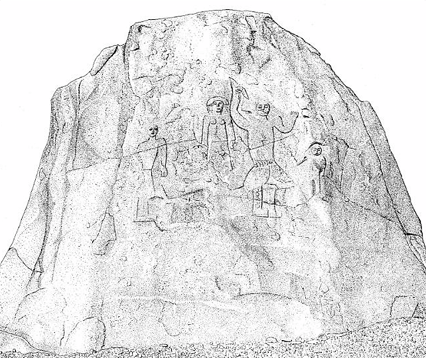
Drawing taken from Yule.P 2001.
A very interesting article on Rock Art in Saudi Arabia from the Saudi Aramco World magazine: published in 2002.

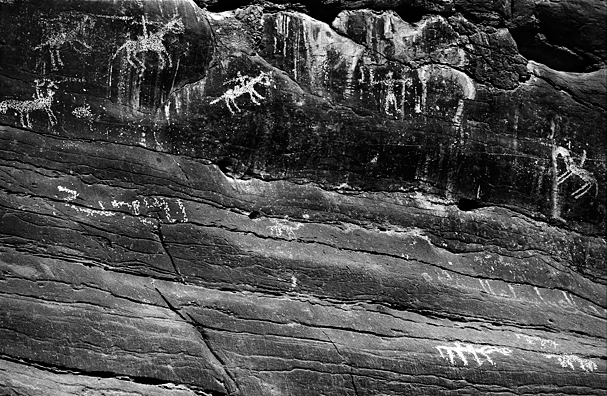
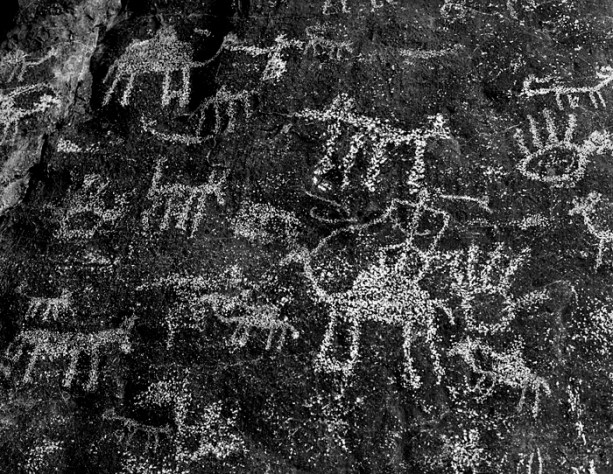
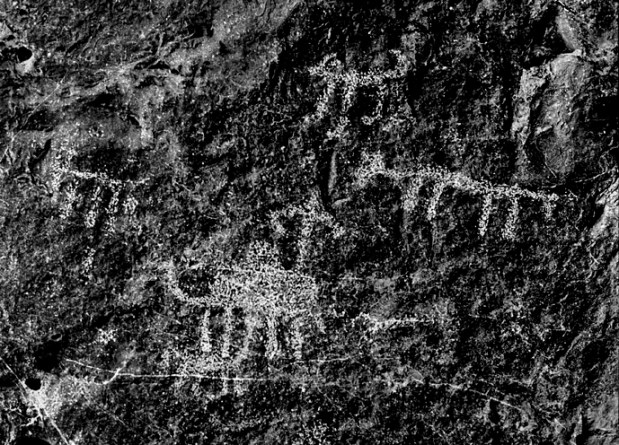
There are numerous rock art sites found here in Oman, but it would seem that its cultural significance is lost on most of the indigenous population.
A search of the internet finds very little on the subject and The Journal of Oman studies has only the odd reference.
It can be rather difficult dating it; but given the subject matter, I would think using examples found in such places as Saudi Arabia and other areas of the Middle East; dating should not be outside the bounds of possibility.
Another reason is that it can be rather hard finding it; given that most of the really old examples are in places that are well off the beaten track. This may be a good thing though, because I have found some sites that have had ‘graffiti’ added (The only description I can come up with when I see ‘Kilroy’ was here or at least the Arabic/tourist equivalent) to pictograms that are maybe hundreds of years old.
 David A Lockwood