
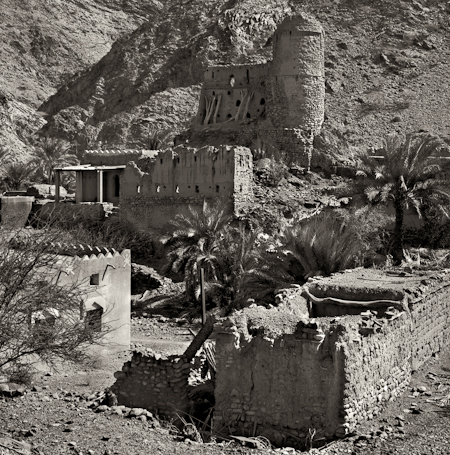
Some interesting links about the ruined village of Tanuf and the The Buraimi – Jebel Akhdar Crises, 1952-1959.
Some interesting links about the ruined village of Tanuf and the The Buraimi – Jebel Akhdar Crises, 1952-1959.
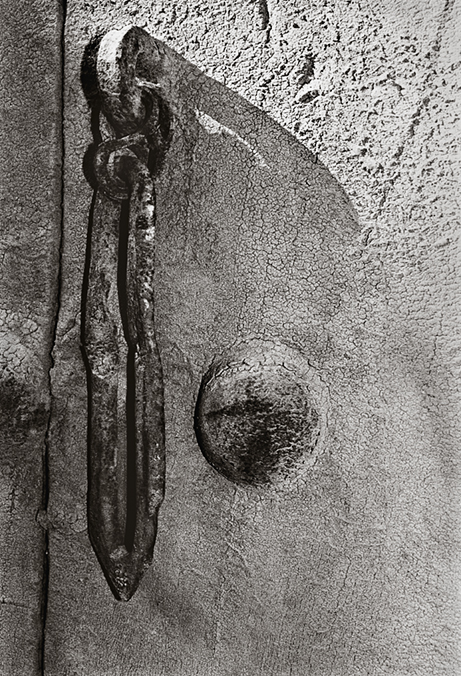
Another interesting article, which I found while going through back issues of Saudi Aramco World magazine.
Oman A History Written by Paul Lunde.
This gives a brief glimpse of the major periods in Oman history – enough for thought and further investigation.
Oman A History Written by Paul Lunde.
saudiaramcoworld oman-a.history

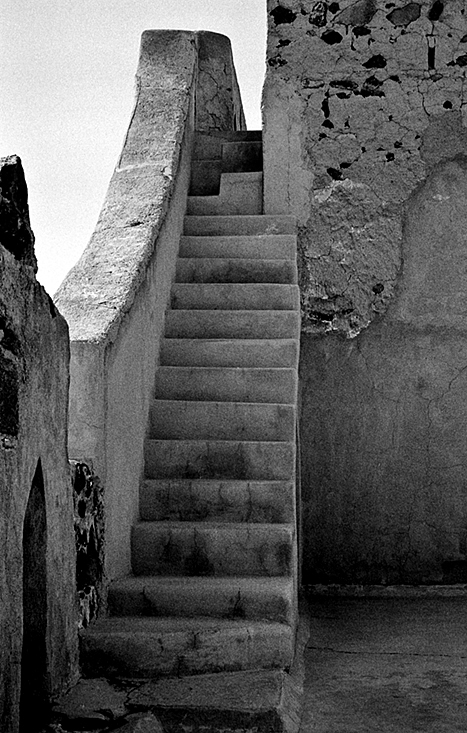
 The advantage of the Bronica S2a – I can use two backs: one colour and the other as in this case, loaded with Iford FP4+.
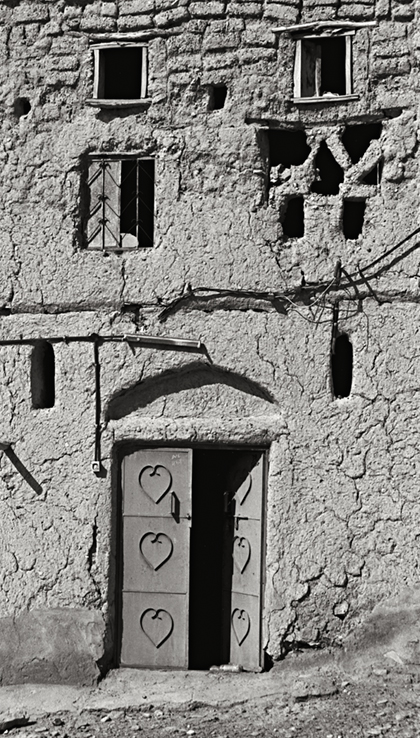
You can only do so much!
The desert is an unforgiving environment, but many fascinating finds can be made, The Huqf being one area geologists, biologists, and those with an archaeological interest find well worth a visit.
Stone Age settlements and flint-factories, particularly around the central Huqf Sabkha, indicate a less hostile environment during the time of stone-age Oman.
Fossilised wood remains can be found at several sites, as the image below shows.
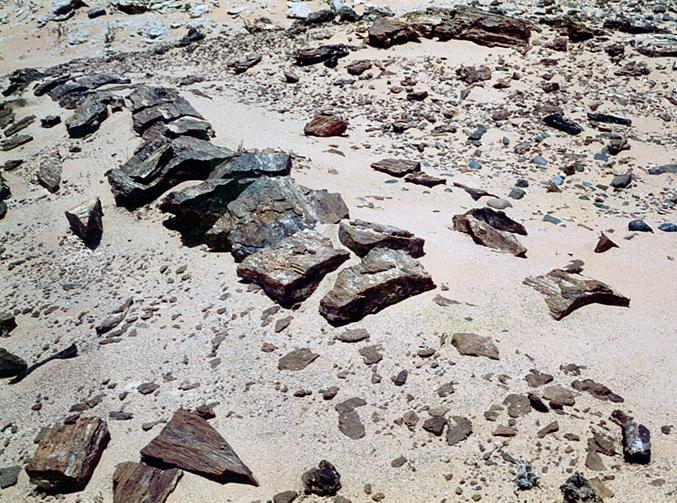
The oldest rocks in this region are about 730 million years, these are basement rocks, a type of granite.
Because it is such a unique place, the Ministry of Municipalities, Environment and Water Resources is working to conserve the natural heritage of this area.

Much of the Huqf lies within the Arabian Oryx Sanctuary, unfortunately a very desirable animal for some unscrupulous people who I am told will pay handsomely for any that are captured: resulting in a never – ending battle with poachers.

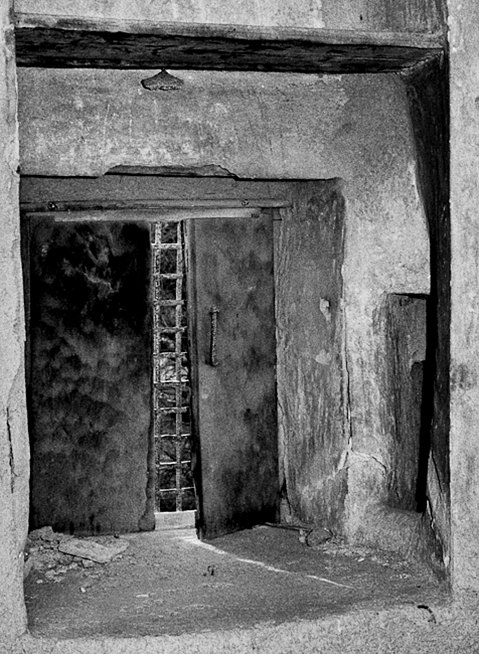
Old door.
Anyone interested in more information about the rock carvings depicted in the previous three images can look at this link.
archiv.ub.uni-heidelberg.de/propylaeumdok
when you open the link Click on: Dokument 1 .pdf (1.455 KB) – it is in English….
For those that have the books, it can be found under: Sacred places in Ancient Oman. Journal of Oman Studies 11: 133-138; Yule, P., 2001. The Hasat Bani Salt in the al-Zahirah Province of the Sultanate of Oman.
Hasat Bani Salt or (Hasat Bin Sult).
A block of limestone near Al Hamra; which has four near life-size human figures depicted in relief on its main face, these having been hammered out of the rock.
Age is not certain, but pre-Islamic and probably in excess of 3000 years old.
It has been disfigured at its base by graffiti! Terrible, because it is one of the most important archaeological finds in this part of the Middle East.
The carvings were “found” in the 1970’s by Coleman, a geologist who made contributions to the understanding of local ophiolites. This is why the rock is known also as ‘Coleman’s rock’.
The rock is at:


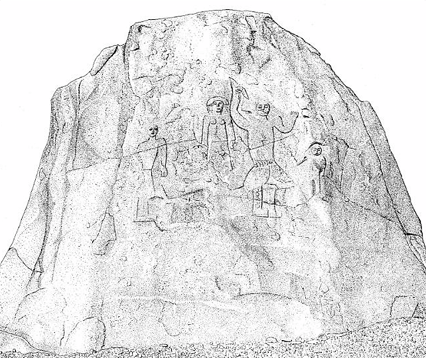
Drawing taken from Yule.P 2001.




A very interesting article on Rock Art in Saudi Arabia from the Saudi Aramco World magazine: published in 2002.


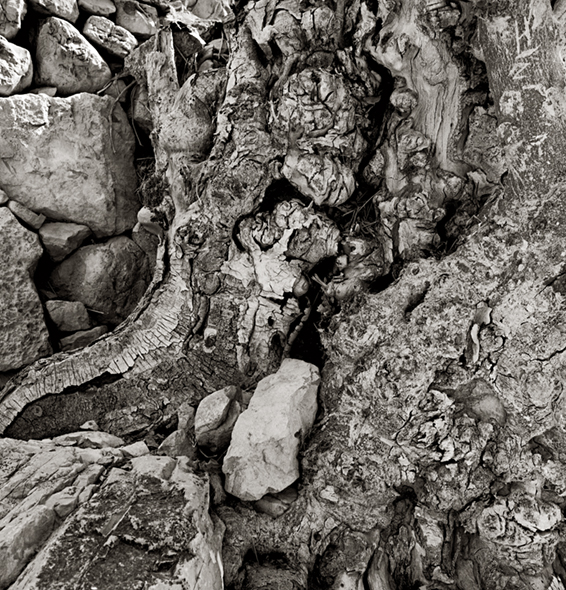
 Kodak – Tri-X 400 at ISO 320.
This was taken using my Micro-Nikkor 55mm f/2.8 AI-s lens on the F2SB camera.
A lens that I think can still be found ‘new’ but there are many excellent used items on the market, it is worth looking out for one in fine condition.
Takes 52mm filters, focuses down to 9″ or so at which point the image has a magnification of 1:2 and can be increased to 1:1 with the use of a PK13 extension ring; one of Nikon’s sharpest lenses.
An excellent optic for both general photography and close-up work; distortion correction remains virtually unchanged over the entire focusing range,
It seems to have a reputation for oil contamination of the aperture leaves, I know several people who have used one of these lenses and none has had this problem. But it may be worth using a bit of caution if buying used.
I never thought I would post a link that went to a Digital camera site but…..
Fuji has come up with a Digital Range Finder that could almost be designed for a photographer (note hint of sarcasm!)
It even has an ‘Optical viewfinder’ where did that come from – what a wonderful idea! Why has no one else thought of it? I must stop this sarcasm….
Yes I know that both Nikon and Canon have put such a view finder on one or two of their digital point & shoot cameras; but they always seem like an afterthought, so let us hope this one lives up to the hype.
 David A Lockwood