Thank you very much Peter – very pleased you take the time-out and look.
Yes I must admit that sometimes I despair that I cannot always get the same ‘look’ on the screen. Dispelled by kind words such as yours. Much appreciated.
Thanks,
I think you are probably right as it was a nice cool area (even with the outside being high 40’s) well I hope so anyway, as the dungeons were way back in the other direction.
Nice one, David. Great composition.
Did you manage to capture all the detail with the first shot or did you have to fiddle with the contrast in PP?.
(I always have to alter the contrast, but I guess you’re better at capturing it correctly in camera).
Many thanks.
Now that would be telling … 🙂
Joking aside, I always use the same procedure I do when using E6 slide film. Expose for the high points and deal with the shadows later. It is a balancing act though and spot metering is the only way because as good as Matrix metering is these days, the light is extreme at this time of year.
I’ve never used the spot metering on my DSLR – must try it sometime. I don’t know enough about the technical side of my camera to get this wonderful contrast in-camera.
I always have to ‘tweak’ my B & W shots or B & W conversions. Wish I could see better in the LCD screen after the shot, but I only have ‘distance’ glasses (the reading ones were just too expensive to get last last year). This year’s test showed my L eye astigmatism is much worse, so maybe more new glasses are on the agenda. I’m finding it extremely difficult to do even the smallest PP on my large screen these days.
Hi Vicki,
Giving some thought to your comment: If you are having difficulty seeing the image on the camera screen ‘don’t bother’ and if spot metering is also difficult then I might have a suggestion that will help.
How good are you with the ‘Histogram’ readout on the screen ? because that will give you most of the information you will need when exposure is difficult – it just takes a bit longer. It will involve adjusting the exposure in manual or adding/subtracting using the +/- camera setting. What you are looking for is a histogram that looks sort of bell shaped without a big sticky-up bit at either end (indicates clipping or no detail as you have gone beyond the cameras exposure range) have a look at this link.
Ho and don’t use the camera B&W setting as this just desaturates the image (not a good way of converting) if you use either P/Shop or the free! GIMP programmes then use ‘Channel Mixer’ see this link:
Hope this helps and that I have not covered ground you already know.
Best of luck with the glasses – you do very well as far as I can see from your website.
David.
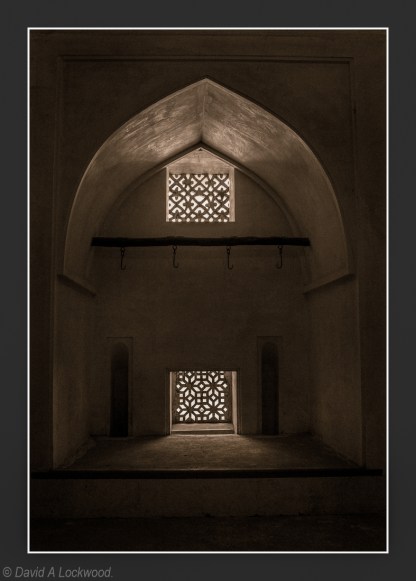 Red/brown tone for a change.
 David A Lockwood
I really enjoy your photography David. These must look brilliant in print!
Thank you very much Peter – very pleased you take the time-out and look.
Yes I must admit that sometimes I despair that I cannot always get the same ‘look’ on the screen. Dispelled by kind words such as yours. Much appreciated.
David.
Very nice, also with the warm tone.
Thank you Bente,
It just seemed to be the right tone somehow.
David.
Super tone, this one great. What on earth are those hooks for? Meat? Or, ahem, people?
Thanks,
I think you are probably right as it was a nice cool area (even with the outside being high 40’s) well I hope so anyway, as the dungeons were way back in the other direction.
David.
Nice one, David. Great composition.
Did you manage to capture all the detail with the first shot or did you have to fiddle with the contrast in PP?.
(I always have to alter the contrast, but I guess you’re better at capturing it correctly in camera).
Many thanks.
Now that would be telling … 🙂
Joking aside, I always use the same procedure I do when using E6 slide film. Expose for the high points and deal with the shadows later. It is a balancing act though and spot metering is the only way because as good as Matrix metering is these days, the light is extreme at this time of year.
David.
I’ve never used the spot metering on my DSLR – must try it sometime. I don’t know enough about the technical side of my camera to get this wonderful contrast in-camera.
I always have to ‘tweak’ my B & W shots or B & W conversions. Wish I could see better in the LCD screen after the shot, but I only have ‘distance’ glasses (the reading ones were just too expensive to get last last year). This year’s test showed my L eye astigmatism is much worse, so maybe more new glasses are on the agenda. I’m finding it extremely difficult to do even the smallest PP on my large screen these days.
Hi Vicki,
Giving some thought to your comment: If you are having difficulty seeing the image on the camera screen ‘don’t bother’ and if spot metering is also difficult then I might have a suggestion that will help.
How good are you with the ‘Histogram’ readout on the screen ? because that will give you most of the information you will need when exposure is difficult – it just takes a bit longer. It will involve adjusting the exposure in manual or adding/subtracting using the +/- camera setting. What you are looking for is a histogram that looks sort of bell shaped without a big sticky-up bit at either end (indicates clipping or no detail as you have gone beyond the cameras exposure range) have a look at this link.
http://www.cambridgeincolour.com/tutorials/histograms1.htm
Ho and don’t use the camera B&W setting as this just desaturates the image (not a good way of converting) if you use either P/Shop or the free! GIMP programmes then use ‘Channel Mixer’ see this link:
http://www.gimp.org/tutorials/Color2BW/#channelmixer
Hope this helps and that I have not covered ground you already know.
Best of luck with the glasses – you do very well as far as I can see from your website.
David.