
 After the storm.
This was taken on Jebel Shams several years ago at about 9900ft and is still one of my favourites.
After the storm.
This was taken on Jebel Shams several years ago at about 9900ft and is still one of my favourites.
Ilford HP5 plus – a good all round 400 ISO film that is quite forgiving when it comes to exposure latitude.
Fuji Neopan 400 – a very nice film that prints well, but rather more critical with exposure.
Kodak T-Max 400 – this film needs very critical exposure control but is excellent if personal film speed is worked out first. (More about that later).
 Sunset Jebel Shams.
 Wadi Bani Habib. Al Jebel Al Akhdar (the Green Mountain),
 Wadi Bani Habib.
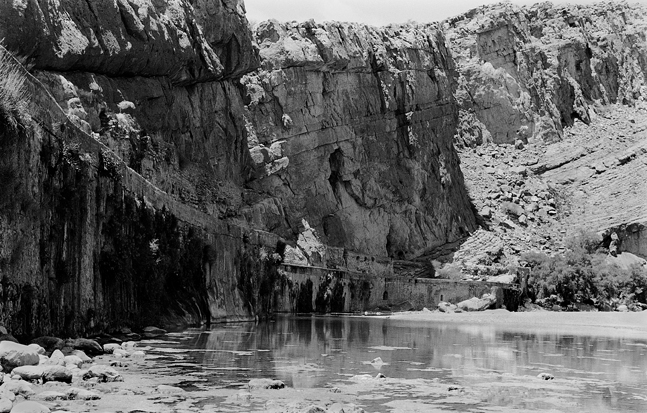 Wadi Tanuf.
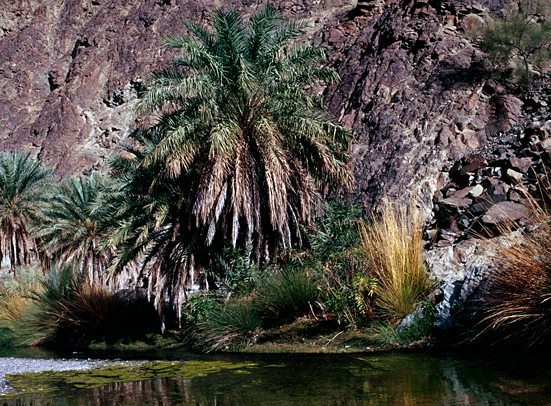 Wadi Al Abyad.
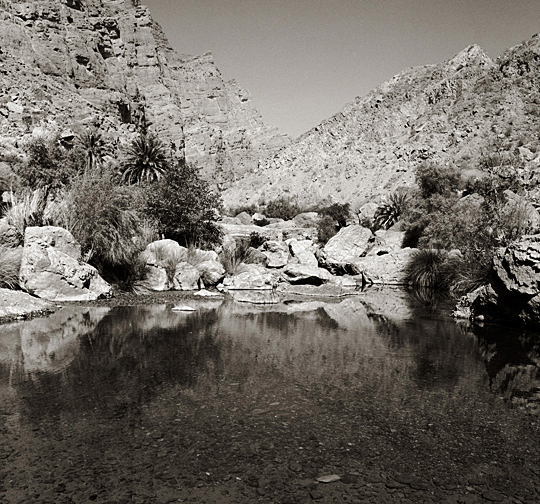 Wadi Bani Habib.

The Rub’ al Khali (Arabic: الربع الخالي).
A really good book!
The Great Game: On Secret Service in High Asia by Peter Hopkirk.
“For nearly a century the two most powerful nations on earth, Victorian Britain and Tsarist Russia, fought a secret war in the lonely passes and deserts of Central Asia. Those engaged in this shadowy struggle called it ‘The Great Game’, a phrase immortalized by Kipling in his book Kim”.
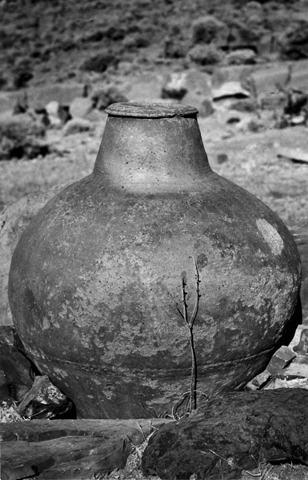 Old storage pot – Jebel Harim Khasab.

Having been in Oman since 1986, I have combined my love of photography with my second great passion, exploring.
Get off the beaten track and find out what this country has to offer…..!
Until Google Earth opened, the only way of finding places of interest was to pick a route and find out where it goes or word of mouth.
But with the help of old Ordinance Survey maps (if you can find them, because they give footpaths used prior to the tarmac road) along with such publications as ‘The Journal of Oman Studies’ it was easy building up a list of places worth a visit. Then it was down to a good 4×4 and two legs!
The Journal of Oman Studies was launched in 1975 by the then Ministry of Information and Culture. It is a publication for archaeologists and historians to present academic articles about the Sultanate (but do not let that put you off). The Journal includes such diverse subjects as the porcelain trade with China, mangrove lagoons, the Kuria Muria (Halaaniyaat Islands) a very important breeding site for seabirds, as well as archaeology and architecture; it has now expanded to cover natural history.
All are available from the bookshop at the Ministry of Heritage and Culture in Muscat.
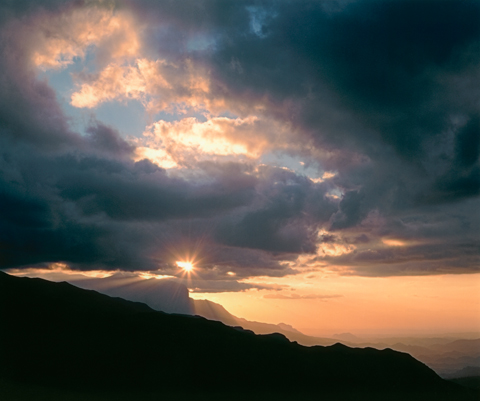 Sunset – Jebel Shams.
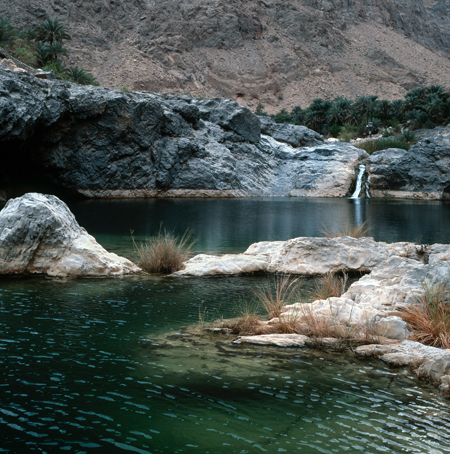 It is not all sand & rocks! 23° 2’5.20″N 58°59’28.61″E
 Boat & nets – Masirah Island.
 Net & boat – Masirah Island.
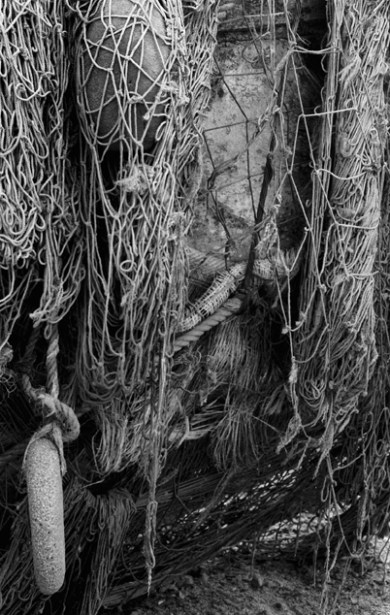 Old nets Masirah Island.
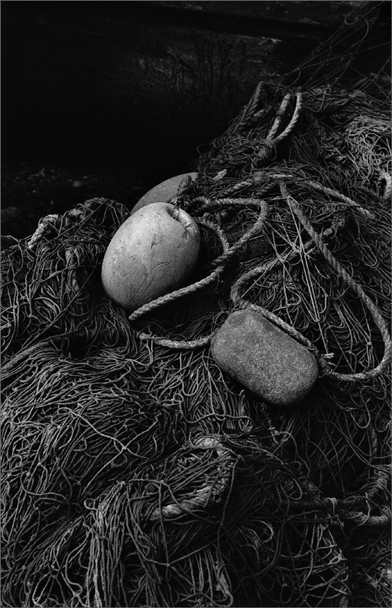 Net & floats – Masirah Island.
These are on a plateau at an altitude of approximately 1758m. and in various degrees of decrepitude some 92 in total (some being only a circle/oval seen from the air): the one I photographed is probably the best preserved on the site at a position:
22°48’55.31″N 59° 3’17.74″E it can be seen quite clearly if you copy this to Google Earth or this link to maps.
The Tomb itself has a preserved height of approximately 6m and is probably late Chalcolithic/Early Bronze Age (3500–2500 BC). Construction must have taken many months not to mention dressing the blocks first; as they have been ‘chipped’ with hammer stones to make the shape needed for construction.
I first visited the site in 1992 or 1993 if I remember correctly, using directions given by a friend and from the nearest town Ibra (Arabic: ابراء ) in the Ash Sharqiyah region of Oman (a 1980’s ordinance survey map & compass – no GPS at that time!). The drive was quite rough going because it involved a lot of off road work searching for a route over or around obstacles. Great fun……
It is still a difficult drive in 2010 but at least the approach from Ibra is now tarmac road.
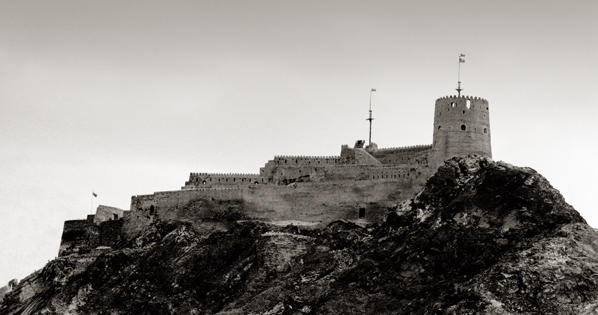 Fort Muttrah.

Another visit to the Umm an-Nar site at Shir Jaylah.
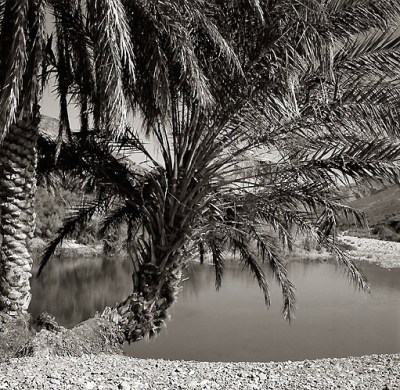 Palm & water.
A little bit of information about some of the cameras I use:
Nikon F2 SB.
The Nikon F2SB was introduced in 1976 to 1977; The F2 range was Nippon Kogaku’s second professional SLR, aimed to replace the highly successful Nikon F.
Nikon F4.
The Nikon F4 (1988 to probably 2000) was the first professional Nikon to offer autofocus and is able to accept any of Nikon’s manual focus or AF lenses from 1959 to the present day. It is probably the best manual focus camera ever to be released as it will meter with just about any lens that Nikon has ever made.
Bronica S2a.
The Bronica S2a introduced in 1969 was one of a number of medium format cameras that used both Nikon and Bronica lenses.
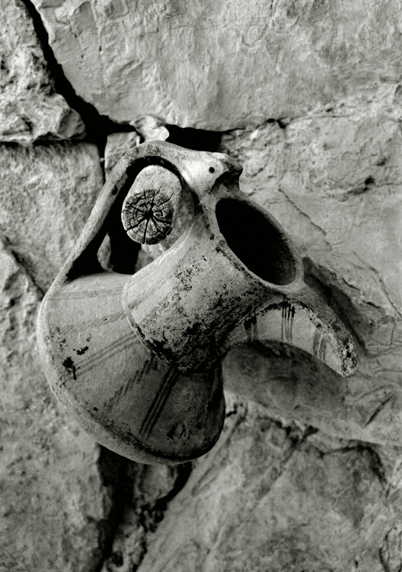 Old coffee jug – abandoned village Jebel Harim Musandam.
Musandam is the most northern governorate of Oman.
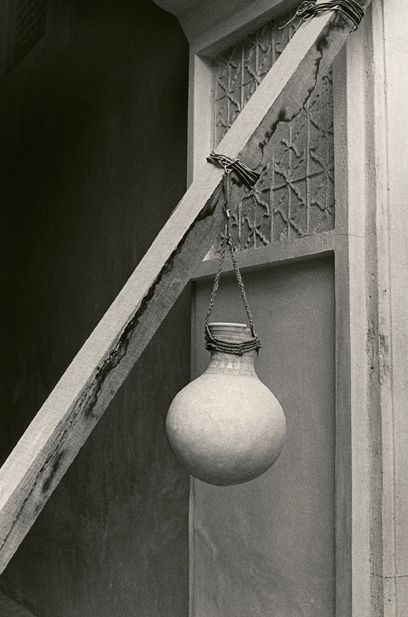 Old pot in Jabreen Fort.
A 17th Century fort originally designed as a country house for Bil’arub bin Sultan bin Saif around 1670 at the height of the Ya’ruba period.
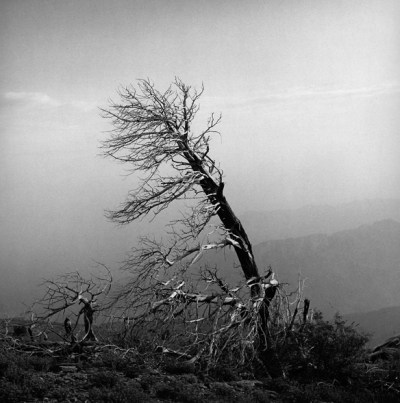 This was taken on Jebel Shams at about 10.000ft.
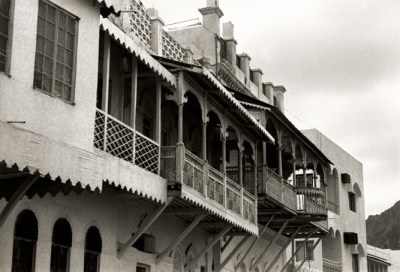 Muttrah Oman.
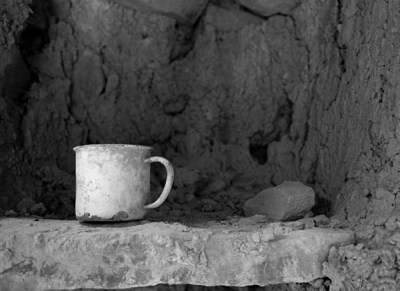 Abandoned cup in old deserted village.
I have been thinking about starting a blog of photographs made here in Oman for a long time.
Anyway here it is – I hope you like it.
A little info about my pictures and the equipment I use.
Copyright
All images appearing in this web site are the exclusive property of David A Lockwood but if you would like to use any of them please contact me – I will probably say yes.
Enough of that.
Film – I have not gone over to the dark side! I just cannot interact with a digital camera, so the nearest I come is using a scanner.
Most of the images are taken with my trusty Nikon F4 or F2 (both really nice intuitive cameras) and for larger negatives I use a Bronica S2a which was a very nice gift from my daughter a few years ago (very good Nikon lenses).
I use a traditional darkroom setup – getting harder to find suppliers here in Oman over the last few years…..
A word of warning, I am terrible with giving information about camera setting, film used and even the place the image was made: But I will try. Google Earth plus GPS is now my friend.
Enough for now, I will add more as I go along; after all this is about photographs not me writing.
 Tomb of the Umm an-Nar period at Shir Jaylah in the eastern Hajjar (جبال الحجر).
 David A Lockwood