Muscat Harbour – ship names.

Visiting Muscat harbour anchorage at the entrance to a bay overlooked by the Sultan of Oman’s Muscat palace; there has been a tradition for ships crew to paint the name of their vessel on the rocks surrounding this bay.
A lot of the names are very faded and can only be read up close from a boat, but one or two are still very distinct; HMS Perseus being one of them.

Now a problem arises:
Received wisdom says the ships name refers to:

HMS Perseus a British Parthian-class submarine built in 1929 and lost in 1941.

But there was another HMS Perseus who spent time visiting Muscat.

HMS Perseus was a 3rd Class, Protected Cruiser.
Built by Earle of Hull, laid down May-1896, launched 15-Jul-1897, and completed 1901.
On completion she went to the East Indies Station, where she spent her entire active service 1901-13.
Returned to the UK and paid off.

The diary of A. Barker whilst in service aboard the Protected Cruiser, HMS Perseus in 1901/03 at the East Indies Station. Starting from 13th September 1901, he makes several entries pertaining to Muscat.

See example of entries below.
13th After smooth passage we arrived at Muscat at 9 am. We saluted the Sultan with 21 guns which was returned.
14th We coaled ship 200 tons.
Time had been rather dull during our time up the Gulf as we had had no leave since we left Karachi so we arranged a seigning (sic) [seining or net fishing is what I think he means]  party, which came off very well.
18th We received the Sultan & the British Consul on board. A salute of 21 guns for the Sultan 11 for the Consul was fired.
20th We had Divine Service which was conducted by the American Minister from ashore
21st We got the starboard bower anchor out, and then we started painting ship.
23rd We had another seigning (sic) party, which was attended by the British & American & French Consul & Mrs Cox. There being no communication from Muscat by telegraph we left Muscat on the 25th for Jask & arrived there the 26th. We left again on the 27th for Muscat.
28th We carried out our firing and arrived at Muscat. We moored ship placing spare bower on the billboard.
29th We unmoored ship and replaced spare bower anchor.
30th We left Muscat at 7.30 am with British Consul & Sultan of Muscat & 150 soldiers onboard, bound for Sur & Khora Jehoram

And another:

HMS Perseus – Light Cruiser 2,135 tons served in The Persian Gulf between 1909 and 1914:
Towards the end of the 19th Century the trafficking of arms in the Persian Gulf area had escalated to dangerous proportions. The British Government pressurised the Governments of Persia and Muscat to take action to bring this business under control. By 1897 Persia had managed to reduce the involvement of their nationals but Muscat was still a serious problem.
So this ship also visited the harbour on several occasions.

But the most interesting is this reference to a HMS Perseus crew painting their ships name in 1857, Made by members of HMS Gambia who visited in August 1958 and did the same thing.

While a few of us had thus been seeing what there was to see, or doing battle on the hockey pitch, a party of stout-hearted individuals had landed on the rocks a few hundred yards from the town where, having scaled a hundred-odd feet of mountainside, they set-to repainting the magic letters GAMBIA on the rock-face, together with the Admiral’s Flag close-by. This was not just a bright idea by one of the boys, but part of a publicity campaign which has been going on ever since H.M.S. PERSEUS painted her name on the brown rock in 1857. As a result, the cliffs either side of Muscat form what is surely the world’s biggest autograph album, for by now they are covered with the names of ships and not only R.N. ones who have visited the place.

The problem is that if the following list is correct, it would indicate that no ship called HMS Perseus existed for that time frame (1857) – so who knows.

Six ships of the Royal Navy have borne the name HMS Perseus.

HMS Perseus was a 20-gun sixth rate launched in 1776; she was the first vessel of the Royal Navy to be sheathed in copper. She was converted to a bomb vessel in 1799 and was broken up in 1805.
HMS Perseus was a 22-gun sixth rate launched in 1812. She was used for harbour service from 1818 and was broken up in 1850.
HMS Perseus was a Camelion-class wooden screw sloop launched in 1861. She was used for harbour service from 1886, was renamed HMS Defiance II in 1904 and was probably sold in 1912.
HMS Perseus was a Pelorus-class protected cruiser launched in 1897 and sold for scrap in 1914.
HMS Perseus was a Parthian-class submarine launched in 1929 and sunk in 1941 during the Second World War.
HMS Perseus was a Colossus-class aircraft carrier launched in 1944 as HMS Edgar but renamed a few months later. She was scrapped in 1958.

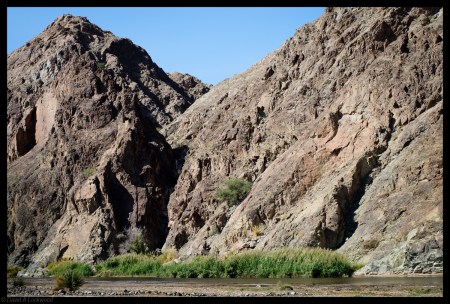
Wadi Al Arbaeen.

Continuing my search through old files – this one from Wadi Arbaeen, Wadi Al Arbeieen, Wadi Arbeen or any other transliteration you might come across      🙂
Wild grass & water R.MdBronica S2a with Nikkor-P 75mm f2.8 & Fuji 100rvp.

This Wadi has been hit by several bad storms in recent years, but is still a good area for camping and walking (trekking) there is always an abundance of water in the upper reaches.

Image was last posted some time in 2013 but made a couple of years before that – when I was able to get plenty of 6×6 colour film and more importantly, chemicals !!!

Santa Claus in Muscat.

Santa Claus

Samsung phone image – Santa Claus even makes it here, all be it a little early.    😉
Carols sung in the Church (Yes there is one) along with festivities at a number of the Hotels over the next few days.
Last bit of shopping before I escape…….. hope everyone has a good holiday when it comes around & a very Merry New Year.

Nikon F4 with the AF-S Nikkor 35mm f/1.4G.


My Nikon F4 with the AF-S Nikkor 35mm f/1.4G.
Made with the D800 and 55mm f2.8 micro Ai-s Nikkor, so opposite ends of the same reasoning.

Out of curiosity I wanted to see how well (if at all) my F4 worked with the 35mm Af-s f1.4G: I can confirm that the F4 lives up to its reputation of being able to take any lens Nikon has ever made.
The lens performs very well with one caveat; no f stop ring meant the only modes I can use are: Program high, program & shutter priority. So the down side was hyper-focal focusing was not an option (overcome by focusing about a 1/3 of the way in to the image) happy days. In shutter priority I could select for aperture by turning the speed control knob and as I quite often use the camera in manual it was not a problem.
The AF focusing was decisive and fast so no worries there, in actual fact it probably means that batteries will last a lot longer. Although in all the years I have had the camera, I have never needed to replace the AA or rechargeable type in the field.
This means that I might just talk myself into buying the  AF-S Nikkor 50mm f/1.8G. The 50mm f1.8 AF that I am using at the moment, has become very imprecise when focusing (age and a lot of use!) also I have the 55mm Micro Ai-s for the manual cameras.
As a matter of interest; why the f1.8 & not the f1.4 – the answer is exactly the same as with the previous 50mm AF lens; price and diminishing returns….. Looking at both lenses, the f1.8 is sharper over most of the range I use and at less cost, so at the price I could afford to do exactly what I am now considering; if I wear it out – get a new one.

If anyone is interested in the two books the camera is sitting on; they are from the Folio Society, see below from their site.

The Icelandic Sagas book image from Folio Society.The Icelandic Sagas
Magnus Magnusson (ed.)
Illustrated by Simon Noyes
Punctuated by a series of eerie illustrations by Simon Noyes, these great Nordic stories of mythology & exploration are chosen and prefaced by Magnus Magnusson.

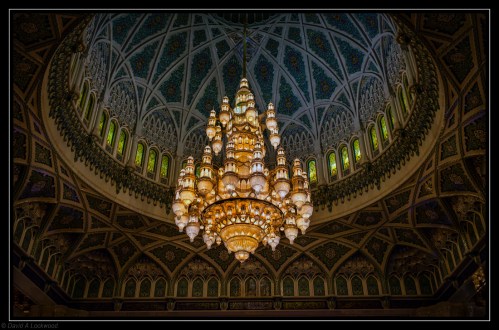
Chandelier – SQGM .

Chandelier SQGMChandelier in the main room – everyone seems to mention the very large hand-made carpet, but I think this view is the pièce de résistance on entering.

I am sorry if this is a little off in quality – needed 1600 iso and -1ev not to mention f5.6: hand-held. I wanted the detail in the chandelier but also preserve some in the ceiling.
All a bit beyond my capabilities – wanted to show how incredible the workmanship was;  almost Elizabethan  in its style.

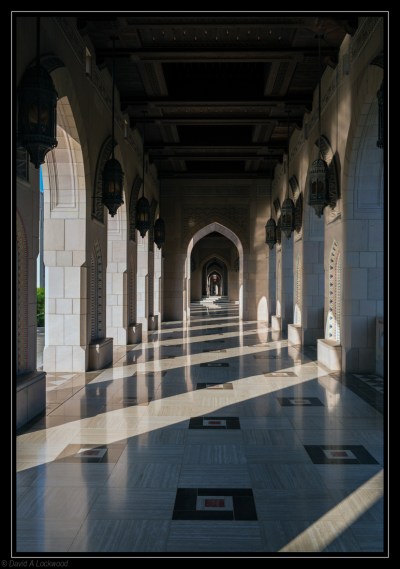
The Sultan Qaboos Grand Mosque.

The Sultan Qaboos Grand Mosque.One of many covered walkways.

In 1992 HM Sultan Qaboos declared that his country should have a Grand Mosque. Building work started in 1995 and it took six years & four months to complete.

As there are National Day holidays over this weekend here in Oman, I decided that rather than joining the crowds escaping the capital, I would visit some of the local attractions.
The Grand Mosque is just down the road from where I live and as I had not been there for a number of years, I thought it was about time I went back.
An architectural delight, that avoids the ostentatious façade of wealth and splendour which a lot of modern building can have. It does have an awe-inspiring visual impact, but in a dignified way; in keeping with many of the great places of religious worship around the world.
I got there before it opened to the public (anyone can visit on any day apart from Friday) so for a couple of hours, was able to walk the grounds with only the gardeners & cleaning staff present. At 08:00 sharp – opening time, I entered the main building which was before most people would be arriving – perfect for making photographs.
A very enjoyable walk around with my camera, no restrictions on using cameras as long as one remembers and respects that the building is a place of worship.
A tranquil and carefree morning out, with a lot of images that I will work on over the coming days.