
 Hanging clasp.
Category: colour.
Rusting Clasp.
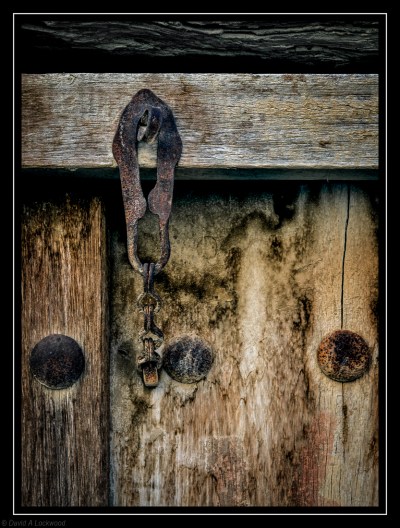 Rusting Clasp.
Another sorry looking lock.
 Locked & forgotten.
Garden flowers.


It is surprising how resilient some of my garden flowers have been with temperatures over 40deg C.
Abandoned food processor.
 Abandoned food processor.
Another from the abandoned theme.
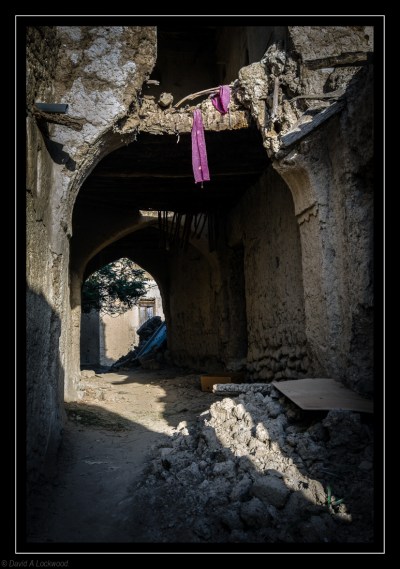 Abandoned scarf.
Things Abandoned.
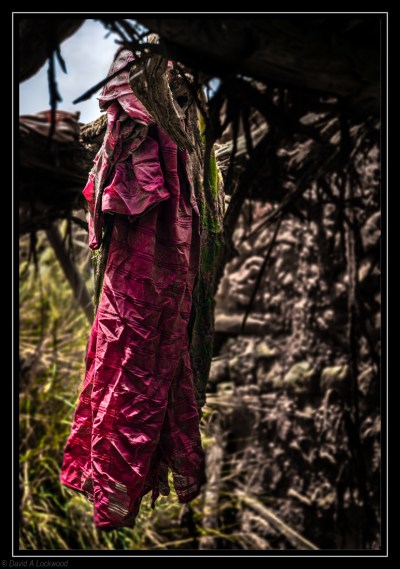 Things Abandoned.
Depending on the age of the village when the last occupant left, but more importantly because the people occupying it had traditional values; theft or putting it rather more euphemistically ‘ borrowed on a permanent basis’ other than in very rare instances, did not exist.
Two observations with this statement: tribal custom means that any of the community uses items that are not of a personal nature and is often misunderstood as theft by outsiders. Modernity brings its own problems.
As a consequence, all sorts of stuff can be found, old storage containers (1950’s ammunition boxes – very popular on the Jebel) pots, bottles, clothes and even the odd suitcase. Don’t get me wrong, there was not a cornucopia full and overflowing, just that old or unusable items just got left and were never touched by anyone else.
A small anecdotal story from my time in Jeddah – I was wandering around an open-air market and saw a stall which was obviously a footwear sellers, but covered in dust (lots !) so I asked about it. The answer was – He died a year or so back & none of the family have claimed the items……. nothing had been touched !
P.S
I made the mistake of editing this post in the ‘new editor’ it took all the paragraphs away !!!!!!
👿
It’s hot outside !
 It’s hot outside – not as bad as it has been but there is about 75% humidity so going nowhere today………
Will stay comfortable and maybe forced into quenching my thirst ! 
From the top of Jebel Shams.
A few quick snaps while I was waiting for some work to be carried out – taken from the very top of Shams: where the tourists can’t get 😉

It’s a long way down !


Step-off and it’s 9000ft with a few bumps on the way.


Cloud shadows. Step-off this one & it’s more like 10,000ft give or take.

Storm coming in the distance.
Pot & Bench Samail Fort.
 Pot & Bench Samail
Beyond the Door – Samail Fort.
 Beyond the Door.
“It’s a dangerous business, Frodo, going out your door.
You step onto the road, and if you don’t keep your feet, there’s no knowing
where you might be swept off to.”
J.R.R. Tolkien, The Lord of the Rings.
Wadi Samail (سمائل).
Wadi Samail from its largest fort: considered to be the biggest valley in Oman.

From Fort tower.


Note all the different ‘transliterations’ of the name – this can make it very difficult researching information, not to mention the total change in a village name over the years.
Samail, Sumail, Samaiyl, Semail………….. سمائل
In 1845, Lieutenant C.S.D.Cole, one of the East India Company’s Surveying crew on the Brig Palinurus, made a journey overland from al-Ashkhara to Muscat via Bidyyah, Sinaw, Manah, Nizwa, the Green Mountain (Al Jabal Al Akhdar) and Samaiyl.
Despite being disguised under the name of ‘Salim’, Cole was always, during his journey, surrounded by immense crowds with great curiosity.
Wherever he went in Oman, he was accommodated and received courteously. In Jalan, he ‘was nearly suffocated with the great quantities of milk’ which the native ideas of hospitality compelled him to swallow.
Leaving Nizwa, on his final route to Muscat, Cole tells us that he halted for a night at a traveller’s bungalow in a village named Mettee (probably Muti or now Imti), noticing that most places in Oman had a building set apart solely for the use of travellers.
His comments on a visit to Sumaiyel (sic) were very complimentary:
I found the place of considerable extent and the most flourishing of any I had seen in Oman. Water was plentiful; the data groves, which are extensive, were in the best condition and everything about looked green and healthy.
Contrast this with an account by Lieut; Colonel S.B. Miles 1885.
In the month of March of this year 1885, a cyclone storm of unprecedented violence had burst over central Oman, causing widespread destruction and misery. It had been followed by a deluge of rain, which had swept down the valleys and poured a devastating flood of water through the villages & settlements and had done incalculable damage to houses and cultivation, while hundreds of thousands of date trees had perished.
Dashed by the cyclone against the precipitous walls of Jebel Akhdar, the clouds had broken and fallen in torrents of rain down the steep gorges and ravines, and had concentrated a mighty wave down the Semail valley, which had carried everything before it.
Makes Gonu (1st to 7th June 2007) sound like a pussy cat by comparison – having lived through it (just) I can tell you it was not good !! so this must have been absolutely dreadful.
In 1876 on a previous visit: Miles also noted that Semail ‘Fard’ dates, one of the finest varieties of this fruit produced anywhere. Is the kind most appreciated and esteemed by the Americans, who are good judges and a very large quantity of boxed Fard dates are annually shipped to New York & Boston markets.
Most of the above found from either the Royal Geographic or National Archives UK.
Old Roots.
 Old Roots.
Afalaj in Misfat Al Abryeen.


Walking around with my new Fuji Xpro1 camera – a nice but frustrating experience.
I found that although it was nice not having a large SLR hanging from my shoulder, using the camera was less than intuitive. This is my fault not the cameras…….. I am so familiar with the layout of Nikon cameras that my fingers would not hit the right button unless I made a conscious effort and looked for which one I needed.
Another annoying problem was that I kept getting lost when it came to the display settings; I like grid lines (available) but they kept disappearing. The preview display would sometimes only show in the viewfinder and this seems to be why I lost the grid lines. I think I will need to re-read the instructions and stop making what for me (I thought) were intuitive selections – the old saying “when in doubt read the instructions ! 🙂 ” is very apt.
Something I did find very good, was having a ‘proper’ viewfinder – none of this holding the camera at arms length and struggling with glare on the back screen.
That said, it was so nice being able to walk around and almost forget I had a camera with me, especially when negotiating difficult terrain.
Old Steps – Misfat Al Abryeen.
 Misfat Al Abryeen.
Entrance – Jabrin Fort
 Entrance – Jabrin Fort: come in and see what we have…..
Jabrin Fort.
 One of the balconies at Jabrin Fort.
Salut – Shrine.
 The Greek looking shrine – Salut.
My camp site – Salut No2.
 My camp site for the night – as you can see, I have all the comforts: spot the can !
The mound of rocks centre right; an early Iron Age burial tomb, so I had plenty of company for the night 🙂
My camp site – Salut.
Camp site behind the hill that has tower tomb & Greek looking shrine – Salut. Just time to get my tent up and a can of Guinness while I cook some food 😎
 My first attempt at using the in-camera panoramic stitch programme of the Fuji X-pro1 & Fujinon 27mm f2.8 lens.
A bit soft, it needs an increase in the iso/shutter speed; not sure which at the moment, so more playing required. It’s also strange using the ‘live-view’ or viewfinder. Years of using 6×6 or SLR viewfinders has made me complacent.
A smallish take anywhere camera that fits into my camel-back pack when out walking/trekking. On sale over the Xmas period in UK, for a very good price ! (with two lenses) so it must be due for replacement. Puts my Nikon F2sb into the dark-ages the way cameras get replaced these days; mind you the Nikon will still be going strong for the next 20 years or more – cannot say that about digital cameras.
As for the camp site: I actually went behind the hill looking for a way up to the monuments – scrambled my way up, only to find the signs of a path and steps on the other side!!!! typical.
Archaeological site of Salut.
Visit to the Archaeological site of Salut.

Iron Age fort

Iron Age fort

Iron Age fort

Iron Age fort

Iron Age fort.

Possible water distribution channels No2


Tower excavation

Tower excavation.
Between Fanjah & Bidbid.
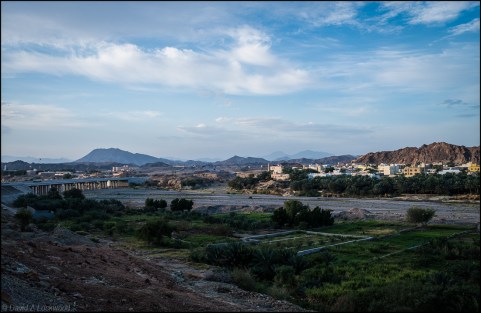 Early morning between Fanjah & Bidbid – just as the sun is coming up.
Bronze Age site of Salut.
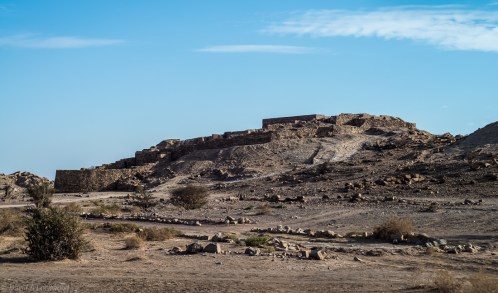 Just a quick image from my latest travels – the Archaeological site – Salut.
I have about 80 unprocessed images & 3 rolls of film, it will keep me out of mischief for a while.
Salut.
Off on my travels again – this time in search of the early Bronze Age site of Salut, some 20 kilometres south of Bahla & Jabrin fort.
A place I have known about for several years, but never visited until now; glad I left it so late because there has been extensive archaeological research carried out recently.
The site has been put forward for inclusion on the UNESCO world heritage list of sites with major historical interest.
It has had extensive human settlement in this area since at least the end of the fourth millennium BC to the present day. Observable by the large concentration of archaeological evidence that can still be seen. There are indications of very large settlements from the Bronze Age (c.3000-1300BC) and following Iron Age (c.1300-300 BC) probably through to the Middle Ages, with farming still carried on in 2015.
Clear Water.
 A CS6 converted Raw file from my Walk through Wadi Qurai post earlier.
Fujifilm X-Pro1 & 27mm f2.8 Fujinon XF Lens.
A walk through Wadi Qurai.

Wadi Qurai. 1

Wadi Qurai. 2

Wadi Qurai. 3

Wadi Qurai. 4

Wadi Qurai. 5

Wadi Qurai. 6

Wadi Qurai. 7

Wadi Qurai. 8

Wadi Qurai. 9

Wadi Qurai. 10

Wadi Qurai. 11

Wadi Qurai. 12

Wadi Qurai. 13

Wadi Qurai. 14

Wadi Qurai. 12

Wadi Qurai. 14
All taken with a Fujifilm X-Pro1 & 27mm f2.8 Fujinon XF Lens.
Camera set on Fuji Velvia mode.
 David A Lockwood