
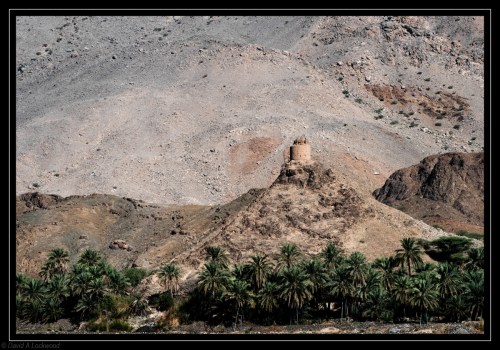
 Tower – Wadi Tayeen,
A Sad Day…….
Tremblez, tyrans et vous perfides,
L’opprobre de tous les partis,
Tremblez ! vos projets parricides
Vont enfin recevoir leurs prix!
Vont enfin recevoir leurs prix!
Tout est soldat pour vous combattre,
S’ils tombent, nos jeunes héros,
La terre en produit de nouveaux,
Contre vous tout prêts à se battre!
The Devil’s Gap.

Davil’s Gap.


Dima wa’Tayeen in the Sharqiya region, will take you to Wadi Tayeen and at Ghubrat at Tam, the Wadi takes a dramatic turn in a breach of the Jebel Aswad range (The Devil’s Gap) from here it takes the name Wadi Dayqah.
Note: Mariners called the sea end The Devil’s Gap but it is now generally known by this name at the Wadi Tayeen end as well.
Lieut, J.R.Wellsted – Travels in Oman 1837 Vol 1. Page 41
Extracts from:
JOURNAL OF EXCURSION IN OMAN, IN SOUTH-EAST ARABIA.
by Colonel S.B. Miles Pub:1838.
&
The Geographical Journal
Vol. 7, No. 5 (May, 1896), pp. 522-537
S. B. Miles.
The town of Ghubra el Tam (sic) is very picturesquely situated on the skirt of an eminence, which, lying at the end of the valley and thus forming a barrier against the onward progress of the stream, has caused it to swerve to the northward and cut its way through the mountain range down to the sea. It has some good houses and a population of over a thousand of the Siâbiyin tribe, and is protected by a strong fort of oblong shape perched on the western extremity of the hill.
At this time there was very little water in the wadi, the unusual dryness of its bed being due to the severe and long-continued drought, from which this part of Oman had been suffering, and our party were congratulating themselves on having arrived at such an opportune time for passing through the gorge, when their joy was suddenly turned into dismay by a slight shower of rain which fell in the evening. The clouds now began to gather so ominously in the sky, that if it had not been so late I should have pushed on at once without halting. It had, however, already become too dark to permit of this, and with some foreboding—for the intensity of the heat seemed to threaten a thunder storm—we took up our quarters for the night in the habitation our hosts the shaikhs of the town had allotted to us. Had it rained heavily, as many of us fully expected, I should have had to wait here until the torrent had subsided sufficiently to allow of our proceeding through the gap, which would undoubtedly have entailed a delay of several days.
The exploration of this caňon had been one of the main objects of my journey, as it had not before been traversed by a European, so I was resolved to seize the present chance of visiting it at all risks. Fortunately, the night passed without the expected downpour, and though the morning of the 16th broke gloomily and lowery, the rain still held off, and the stream flowing at our feet had risen but slightly. After a consultation, we deemed it best to face the peril of a sudden rush of water through the gorge, and hazard the passage before the storm, which now appeared inevitable, could burst upon us and unite the rills and streamlets of the valley into a swift and overwhelming torrent. having hastily loaded the camels, therefore, we started early, and crossed the bed of the wadi, in which the water was running a little over 2 feet deep, just opposite the town. We then found ourselves at once at the entrance of the great cleft, which is as sharp and abrupt as if we were entering the portals of some monstrous castle and stood immured within its massive walls. Towering loftily, sheer and perpendicular above the narrow floor, the huge walls of rock give the appearance as if the mountain range had been suddenly split in two from the base to the summit by some convulsion of nature, exhibiting a singular illustration of impressive grandeur. The breadth of the passage here is about 100 yards, but it varies throughout its length from 500 to 150 yards, while the cliffs rise to an altitude of from 1000 to 1500 feet, as near as I could judge. The stream appeared to flow 4 or 5 miles an hour, and gradually increases in volume as we progress, being fed by the springs of water which burst from the crevices in the walls. Throughout the chasm the camels were wading nearly up to their knees.
After riding along this grand and curious gallery for a quarter of a mile, we are told to dismount, having arrived at a sort of deep step or waterfall called the Akaba. Here the camels are relieved of their baggage and saddles, and are taken along a ledge of the precipice on the left bank which leads circuitously to the bed further on, while the men of our party are let down by a rope over the projection on to the floor of the wadi below. This remarkable stop or fall in the rock offered a very serious impediment, as it was of considerable depth, while huge blocks and fragments of blue and white limestone, that had fallen from above, added lo the difficulty, and presented an obstacle which was absolutely insuperable to the camels, even when freed of their loads. The path leading to the fall, along which we had to scramble, was so rugged and slippery, and the cliff was so smooth and waterworn, that even the Arabs, who are as nimble as cats, did not find it easy work.
The solicitude evinced for my safety, not only by my own party, but also by the Siabiyin who had accompanied us from Ghubreh was almost touching, though the descent could not in fact be called perilous. Indeed, throughout my excursions in Oman, 1 always had reason to he grateful to the Arabs of my escort, and not infrequently to the local Arab shaikhs, for their zeal and self-sacrifice on my behalf. They never resented the inconvenience and fatigue 1 often caused them, but deferred without question to my wishes as to the when and the whither; while on any occasion of unusual toil or danger, they seemed to regard my safety and comfort as a main point of consideration.
At the bottom of this pass, called Al Makuba by our Siabiyin guides, we waited an hour for the camels, which, though carefully led by the drivers, did not traverse the narrow and dangerous ledge on the other hank without serious difficulty and hazard. Fortunately, however, they arrived at last in safety, and the baggage, which had in the mean time been lowered down by the Arabs, having been replaced, we mounted and resumed our journey.
“we are told to dismount, having arrived at a sort of deep step or waterfall called the Akaba.”
This is still a difficulty even in 2015 !
Extracts from:
THE COUNTRIES AND TRIBES
OF THE PERSIAN GULF.
Pub: 1919 by COLONEL S. B. MILES
Al-Sharkiya, as its name implies, denotes the most easterly province of Oman, and is bounded on two sides by the sea, on the south-west by the desert, and divided from Oman Proper by the hill range, as described above. It is mountainous to the north along the coast, the highest peak being Sohtari, which rises over 6,000 feet,and to the south-west it is more level, more fertile, and more populous.
The northern part of Al-Sharkiya is drained by the Wady Tyeen, which flows into the Gulf of Oman, while in the south the watershed throws off four streams, Ethli, Andan, Halfam, and Kalbuh, all of which unite in one and discharge into a creek a little to the east of Mahot in the Bahr al-Hadhri. This province includes three or four luxuriant and well-watered districts, the Tyeen Valley, Jaalan, Bediyeh and by some Semed al-Shan.
The first of these is a perennial and important stream occupied by more than thirty villages, and after cutting a deep chasm through the hills known to mariners as the Devil’s Gap, reaches the sea at Dagmar, east of Kuriyat.
The great valley called by the Arabs Wady Thaika, or Hail Ghaf, and known to Europeans as the ” Devil’s Gap,” a narrow cafion cut through the hills by the water of the Wady Tyeen ; the bluff on the northern side of the gap is called Nuwai, while that on the southern is called Naab.
Three Day Road by Joseph Boyden.

The moving story of two Cree Indians from Moose Factory Canada: who became snipers in the Great War.
An intense description of trench war interspersed with an account of what it was like being Indians, forcibly taken as children, from their families. Then ‘educated’ as Canadians with knowledge of their own ways and language forcefully eradicated.
“Taking the Three Day Road”, a traditional Cree reference to dying, is given a new meaning by the narrative of Niska, an aunt to one of the men. She escaped from the education system and carried on her life as an Oji-Cree medicine woman, but is now trying to bring one of the two home on his return from the front. He is physically and mentally wounded by his experiences; she is determined to save him.
In Remembrance of the Great War:
In Flanders fields the poppies blow
Between the crosses, row on row,
That mark our place; and in the sky
The larks, still bravely singing, fly
Scarce heard amid the guns below.
We are the Dead. Short days ago
We lived, felt dawn, saw sunset glow,
Loved and were loved, and now we lie
In Flanders fields.
Take up our quarrel with the foe:
To you from failing hands we throw
The torch; be yours to hold it high.
If ye break faith with us who die
We shall not sleep, though poppies grow
In Flanders fields.
John McCrae, May 1915
Abandoned village first light.
 Abandoned village first light.
Toning experiments.
Toning experiments…….


From my verandah.
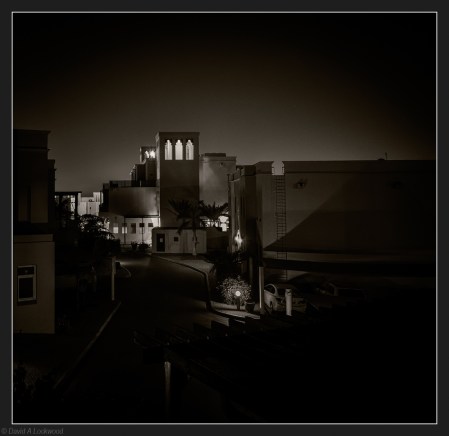 From my house.
Early morning – passing Jabrin Fort.
 Jabrin Fort.
Tombs: Qubur Juhhal – Al Ayn.
 Tombs: Qubur Juhhal – Al Ayn.
Another from my Flower series.
 A Single flower….
Nikon F3 with Tokina 35-70 f2.8 AT-x lens.
Arch with Door – Ruins.
 Ruins.
This was made on a visit to a very dilapidated building – all the plaster was very crumbly & turned sandy if touched.
Anywhere else & I would never have been allowed in; for safety reasons (read ‘jobs worth’). But this is Oman ! so coffee & dates and polite conversation with the custodian, along with an explanation that I wanted photographs before it fell-down completely 🙂
Window with shutters.
 Derelict …… !
Pushed Kodak Tri-x: normally printed on textured art paper with a brown tone applied.
A Foggy Day.
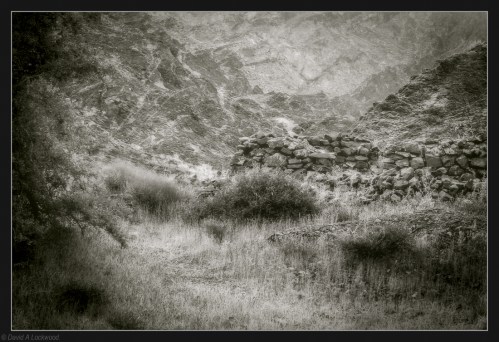 Foggy Day.
Abandoned Ruin.
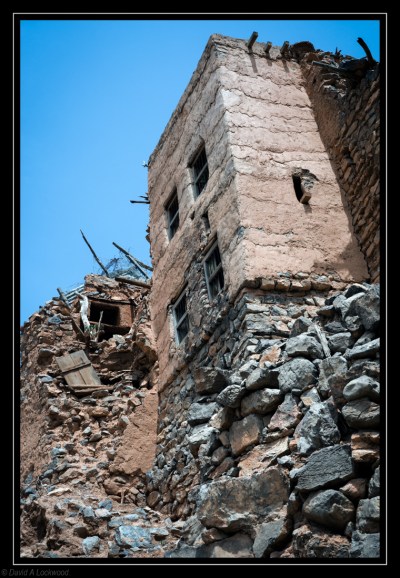 Abandoned ruin.
Shadows with Decorative window.
 Shadows with Decorative window.
Nikon F4 – Kodak Plus-x @ asa 100.
Angles & Shadows.
 Angles & Shadows.
Nikon F4 Kodak Plus-x @ asa 100.
A Flower……
 A Flower……
A Musandam Hermitage.
 A Musandam Hermitage.
The three buildings in the above image, was the home of an old gentleman who as far as I could tell, had cut himself off from his immediate family and lived a very solitary life.
Unfortunately he is now deceased; although I did have the pleasure of meeting him on a few occasions when he was walking the mountain tracks.
I remember the first time I saw him, he was walking back from one of the local villages and I stopped in case he wanted a lift. He scrambled in and proceeded to have a loud and unintelligible conversation with me (it was some form of local dialect – probably Kumzari [see below] interspersed with the local Arabic) I can get by poorly ! with the later but not a hope with the former.
Over the months, I picked him up a number of times and was greeted with a big toothy smile along with the inevitable loud unintelligible chatter. I said yes & no interspersed with insha’Allah when I thought it appropriate; he always left with profuse expressions of thanks, so I must have avoided giving offence.
This is in no way meant to sound disrespectful, but – the expectations of someone living alone in the mountains above Khasab are that they would not present the most hygienic of demeanours….. Far from it, he was clean and what struck me as rather odd, very soft hands, but with a firm handshake. So although the place looks very desolate and unkempt, he was most fastidious about his appearance; albeit rather bedraggled.
I was sad when I heard that he had died.
From that well-known online encyclopædia:-
Kumzari.
The Kumzari name derives from the historically rich mountainous village of Kumzar. The language has two main groups of speakers, one on each side of the Strait of Hormuz: by the Shihuh tribe of the Musandam Peninsula and by the Laraki community of Larak Island in Iran. On the Musandam Peninsula, the Kumzar population is concentrated in Oman, in the village of Kumzar and in a quarter of Khasab known as the Harat al-Kumzari. In addition, Kumzari is found at Dibba and the coastal villages of Elphinstone and the Malcolm Inlets. It is the mother tongue of fishermen who are descendants of the Yemeni conqueror of Oman, Malek bin Faham. Based on linguistic evidence, the presence of Kumzari in the Arabia region exists prior to the Muslim conquest of the region in the 7th Century A.D.
Although vulnerable, it survives today with between 4,000 and 5,000 speakers.
Early morning mist – Nakhal.
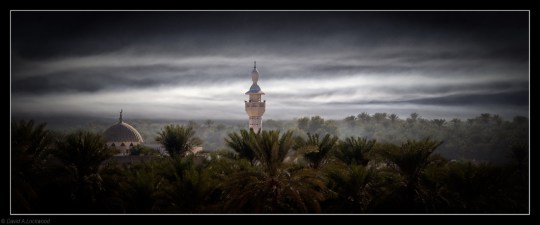 Reinterpreted Early morning mist – Nakhal
Musandam.
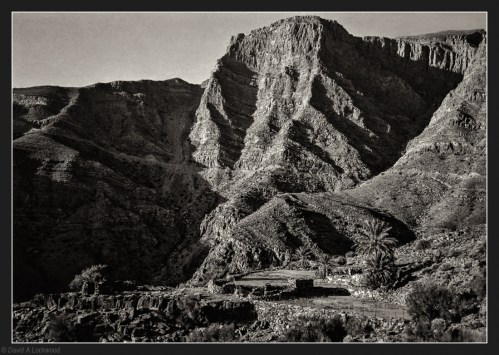 Nikon F4 with Tokina 35-70 f2.8 AIS AT-X.
This is from a negative that I saved after a whole file of them got wet when my house was inundated several years ago 😦
Thankfully a good soak in Photo-flo solution was able to save a good number of them. Although as you can see, there is some damage in the sky area as this was made on Ilford XP2 which is a dye cloud film, so not as hardy.
Most were images I had taken when I was working in the Musandam.
A little bit of history as to why Oman is split into three parts – Oman, Madha & The Musandam.
It goes back to the formation of the UAE in 1971. Prior to this, the area was little more than a collection of sheikhdoms (unlike Oman by this time) with not much in the way of formalised government. It was administered by the British as Oman & the Trucial States.
When the British withdrew from the region a decision was made to form the Trucial States into a single country, the United Arab Emirates. As you can probably imagine, there was a great deal of debate over which parts were owned by which sheikh.
Some areas were easy but were there was the possibility of dispute; the British simply asked the villagers which sheikh they owed their allegiance to. Madha decided to pledge their allegiance to Oman, so they become Omani.
With regards to Musandam; this has significant strategic importance as, with Iran, it allows control over the Straits of Hormuz. Hence Oman was able to maintain control of The Musandam in these negotiations, but didn’t win the rest of the coast, which is why Musandam is also not connected to the rest of Oman.
Mountain stream – B&W conversion.
 Mountain stream – B&W conversion with ‘channel mixer’ CS6.
Rushes & rock detail.
 Nikon F4 with Micro-NIKKOR 55mm f/2.8 AI-s on Kodak Plus-x @ Asa: 125.
Samail.
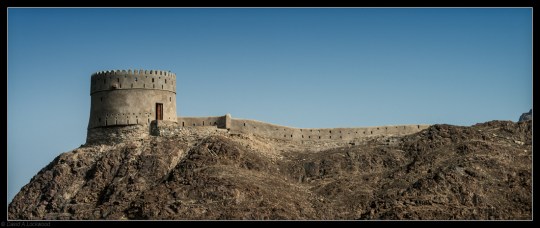 Samail Fort & Wall.
Dead & beyond help.
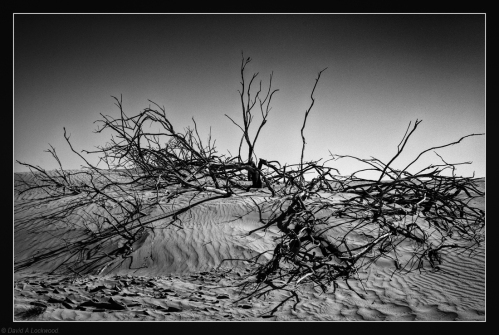 Spot the bird…..
Water will not help !
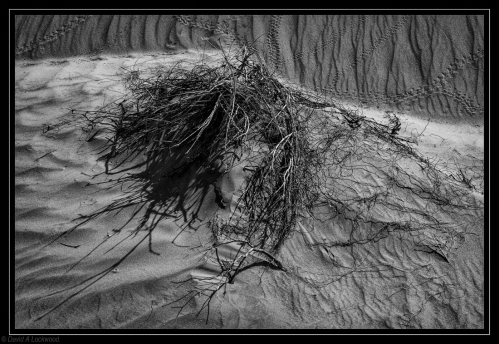 Above is an edit of the image for more detail in the shadows:
found on some monitors that they tended to absolute black (see below – original post) which was not my intention.
 Beyond any help.
 David A Lockwood