
 Angles & Shadows.
Nikon F4 Kodak Plus-x @ asa 100.
Angles & Shadows.
Nikon F4 Kodak Plus-x @ asa 100.
 A Musandam Hermitage.
The three buildings in the above image, was the home of an old gentleman who as far as I could tell, had cut himself off from his immediate family and lived a very solitary life.
Unfortunately he is now deceased; although I did have the pleasure of meeting him on a few occasions when he was walking the mountain tracks.
I remember the first time I saw him, he was walking back from one of the local villages and I stopped in case he wanted a lift. He scrambled in and proceeded to have a loud and unintelligible conversation with me (it was some form of local dialect – probably Kumzari [see below] interspersed with the local Arabic) I can get by poorly ! with the later but not a hope with the former.
Over the months, I picked him up a number of times and was greeted with a big toothy smile along with the inevitable loud unintelligible chatter. I said yes & no interspersed with insha’Allah when I thought it appropriate; he always left with profuse expressions of thanks, so I must have avoided giving offence.
This is in no way meant to sound disrespectful, but – the expectations of someone living alone in the mountains above Khasab are that they would not present the most hygienic of demeanours….. Far from it, he was clean and what struck me as rather odd, very soft hands, but with a firm handshake. So although the place looks very desolate and unkempt, he was most fastidious about his appearance; albeit rather bedraggled.
I was sad when I heard that he had died.
From that well-known online encyclopædia:-
Kumzari.
The Kumzari name derives from the historically rich mountainous village of Kumzar. The language has two main groups of speakers, one on each side of the Strait of Hormuz: by the Shihuh tribe of the Musandam Peninsula and by the Laraki community of Larak Island in Iran. On the Musandam Peninsula, the Kumzar population is concentrated in Oman, in the village of Kumzar and in a quarter of Khasab known as the Harat al-Kumzari. In addition, Kumzari is found at Dibba and the coastal villages of Elphinstone and the Malcolm Inlets. It is the mother tongue of fishermen who are descendants of the Yemeni conqueror of Oman, Malek bin Faham. Based on linguistic evidence, the presence of Kumzari in the Arabia region exists prior to the Muslim conquest of the region in the 7th Century A.D.
Although vulnerable, it survives today with between 4,000 and 5,000 speakers.
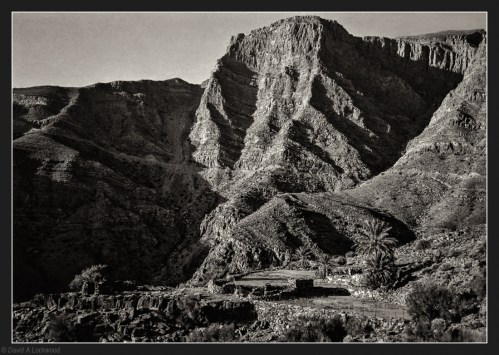 Nikon F4 with Tokina 35-70 f2.8 AIS AT-X.
This is from a negative that I saved after a whole file of them got wet when my house was inundated several years ago 😦
Thankfully a good soak in Photo-flo solution was able to save a good number of them. Although as you can see, there is some damage in the sky area as this was made on Ilford XP2 which is a dye cloud film, so not as hardy.
Most were images I had taken when I was working in the Musandam.
A little bit of history as to why Oman is split into three parts – Oman, Madha & The Musandam.
It goes back to the formation of the UAE in 1971. Prior to this, the area was little more than a collection of sheikhdoms (unlike Oman by this time) with not much in the way of formalised government. It was administered by the British as Oman & the Trucial States.
When the British withdrew from the region a decision was made to form the Trucial States into a single country, the United Arab Emirates. As you can probably imagine, there was a great deal of debate over which parts were owned by which sheikh.
Some areas were easy but were there was the possibility of dispute; the British simply asked the villagers which sheikh they owed their allegiance to. Madha decided to pledge their allegiance to Oman, so they become Omani.
With regards to Musandam; this has significant strategic importance as, with Iran, it allows control over the Straits of Hormuz. Hence Oman was able to maintain control of The Musandam in these negotiations, but didn’t win the rest of the coast, which is why Musandam is also not connected to the rest of Oman.
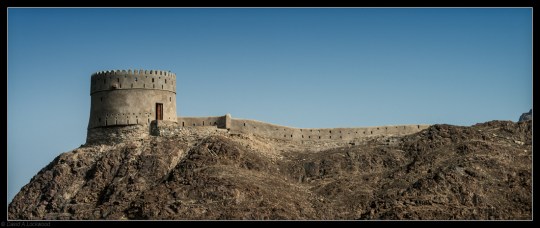 Samail Fort & Wall.
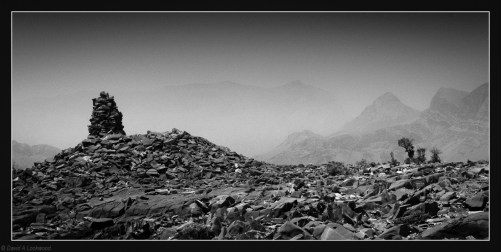 Cairn – Jebel Shams.
I have no idea of its age; always been there, say the locals – there are the remains of early Iron age tombs – see below and (if you know where to look) stone house foundations of probably the same period.
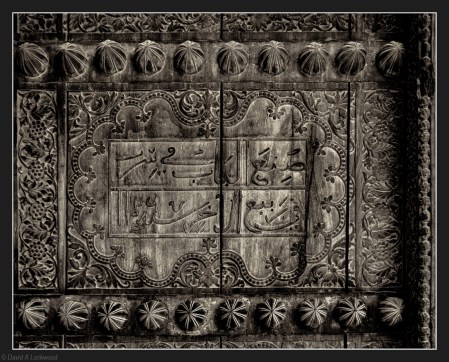 Another door 🙂
 Corridor Jabrin Fort.
 Door fittings.
 Nikon F4 with AF Nikkor 50mm f1.8 lens. Made on T-Max 400 @ iso 320.
 For anyone interested in a little bit of information about the latest archaeological research regarding the Necropolis of Bat, of which the two tombs depicted above are part. See the link below:
Proceedings of the Seminar for Arabian Studies 45 (2015): Stephanie Döpper.
2014_SemArab_Doepper
Click the above link & click again on the new page – it will open a pdf file.
She discusses the reuse of Umm an-Nar tombs in the area and some of the interesting finds being made.
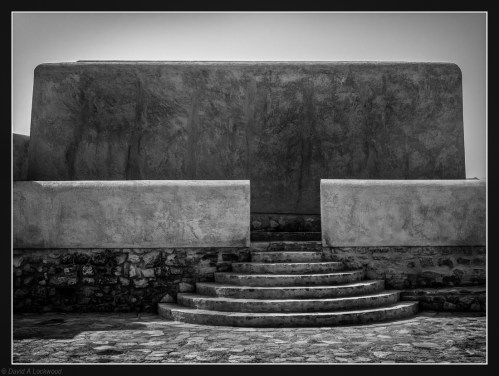 A folly ?


Ancient grave site on Masirah Island with mostly a Nne. Ssw. orientation – I have no idea of age, but it has not been enclosed with a wall by the government so almost certainly pre-Islamic, although there is a mixture of styles.
No indication of an adjoining settlement and so far nothing from my search on the internet.
Several have very old crumbly scallop shells placed on them & vary in size from child to adult.
 Hanging clasp.
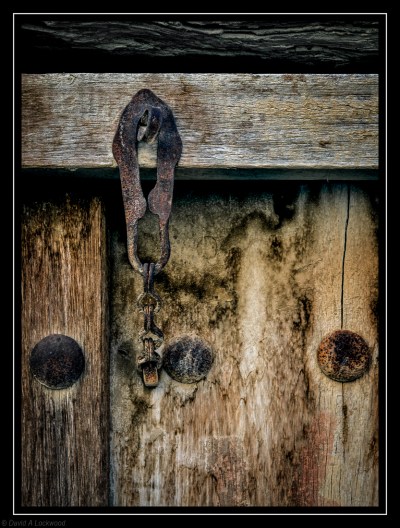 Rusting Clasp.
 Locked & forgotten.
 The lonely lock.
 Abandoned food processor.
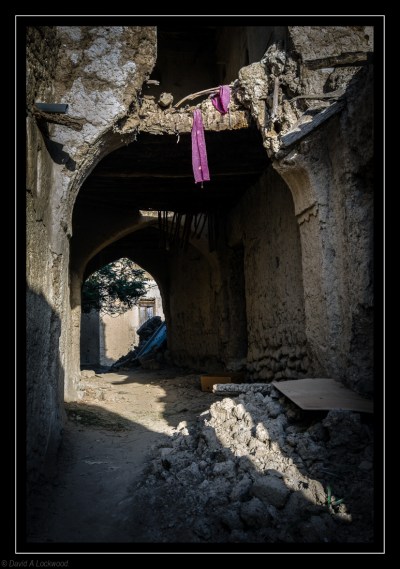 Abandoned scarf.
 Abandoned suitcase.
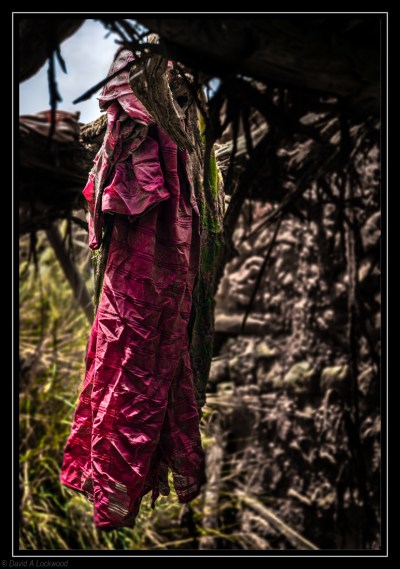 Things Abandoned.
Depending on the age of the village when the last occupant left, but more importantly because the people occupying it had traditional values; theft or putting it rather more euphemistically ‘ borrowed on a permanent basis’ other than in very rare instances, did not exist.
Two observations with this statement: tribal custom means that any of the community uses items that are not of a personal nature and is often misunderstood as theft by outsiders. Modernity brings its own problems.
As a consequence, all sorts of stuff can be found, old storage containers (1950’s ammunition boxes – very popular on the Jebel) pots, bottles, clothes and even the odd suitcase. Don’t get me wrong, there was not a cornucopia full and overflowing, just that old or unusable items just got left and were never touched by anyone else.
A small anecdotal story from my time in Jeddah – I was wandering around an open-air market and saw a stall which was obviously a footwear sellers, but covered in dust (lots !) so I asked about it. The answer was – He died a year or so back & none of the family have claimed the items……. nothing had been touched !
P.S
I made the mistake of editing this post in the ‘new editor’ it took all the paragraphs away !!!!!!
👿
 It’s hot outside – not as bad as it has been but there is about 75% humidity so going nowhere today………
Will stay comfortable and maybe forced into quenching my thirst ! 
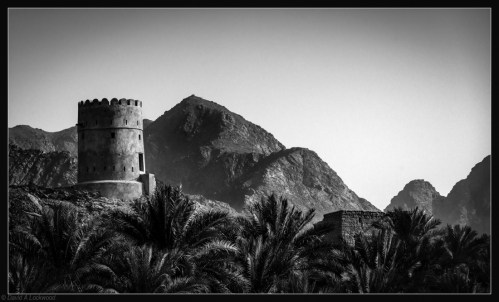 Hill Watchtower.
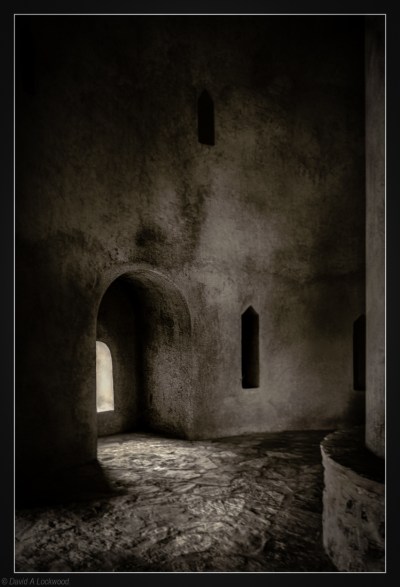 Curved tower windows.
 Multiple Angles.
 Pot & Bench Samail
 David A Lockwood