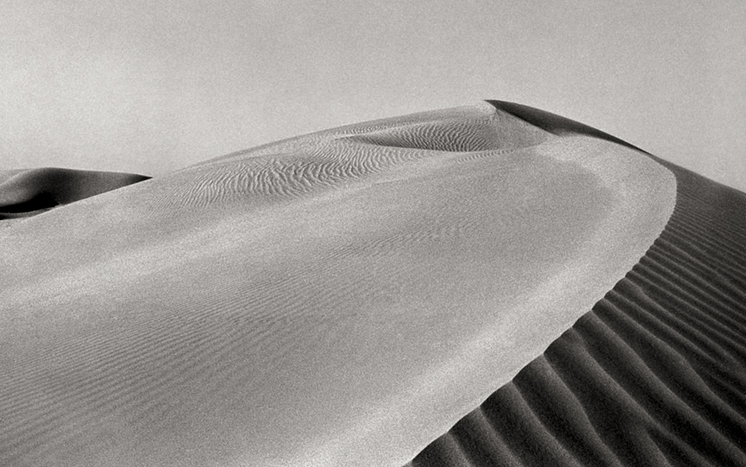
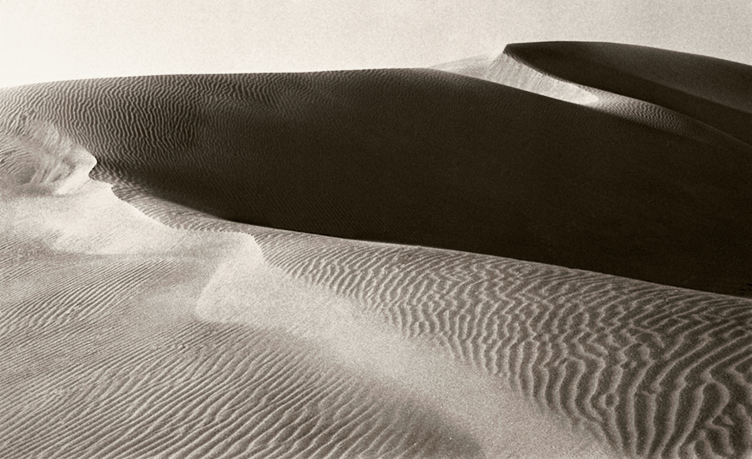
Rub’ al Khali (الربع الخالي‎).

You need to be up early! for this sort of light.

(From the Encyclopaedia Britannica.)

The Rubʿ al-Khali sand desert, covering about 250,000 square miles (650,000 square km)  is the largest area of continuous sand in the world. The topography is varied. In the west the elevation is as high as 2,000 feet (610 m) and the sand is fine and soft, while in the east the elevation drops to 600 feet (183 m) with sand dunes, salt flats, and sand sheets. One of the driest regions in the world, it is virtually uninhabited and largely unexplored.

Bedouin jewellery.

Traditional Bedouin jewellery is becoming harder to find in the souks: for those who remember the old souk in Nizwa, that was the place to find it – but now gone, along with the jewellery. Modernity has a lot to answer for, especially when culture and tradition make way for the new….

One can still find items in the souk at Muttrah but sometimes its age is questionable

As an aside: why do I always find information about Oman’s History and culture from outside sources – Looking at published information; very little comes from Oman, why? Maybe one day Oman will wake up and find out how interesting its culture and history really is…

Here on Bedouin jewellery from the Aramco magazine.

the.beauty.of.bedouin.jewelry.

bangles.from.the.sands.

..

The Huqf.

The desert is an unforgiving environment, but many fascinating finds can be made,  The Huqf being one area geologists, biologists, and those with an archaeological interest find well worth a visit.

Stone Age settlements and flint-factories, particularly around the central Huqf Sabkha, indicate a less hostile environment during  the time of stone-age Oman.

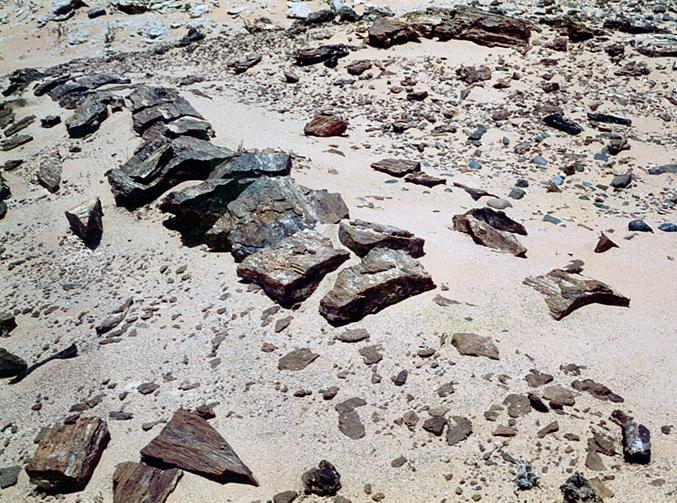
Fossilised wood remains can be found at several sites, as the image below shows.

The oldest rocks in this region are about 730 million years, these are basement rocks, a type of granite.

Because it is such a unique place, the Ministry of Municipalities, Environment and Water Resources is working to conserve the  natural heritage of this area.

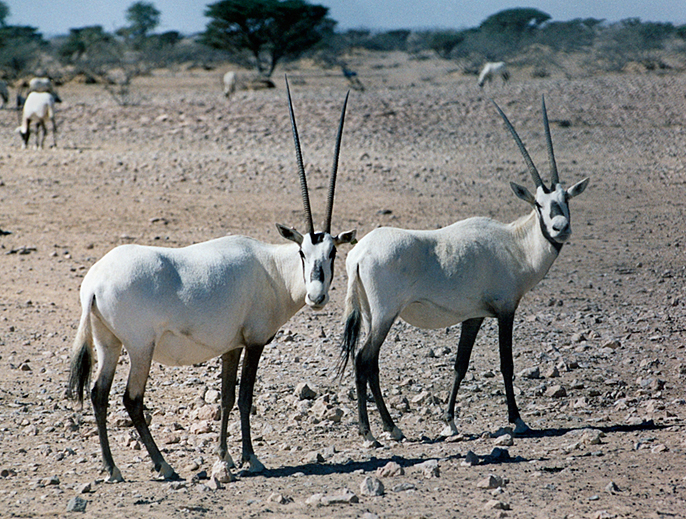
Much of the Huqf lies within the Arabian Oryx Sanctuary, unfortunately a very desirable animal for some unscrupulous people who I am told will pay handsomely for any that are captured: resulting in a never – ending battle with poachers.

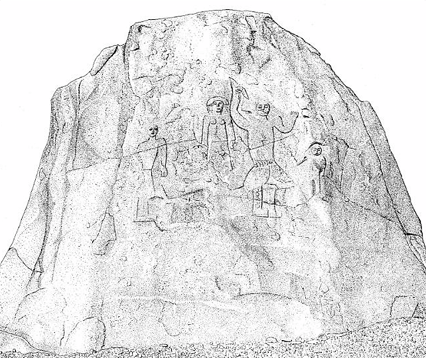
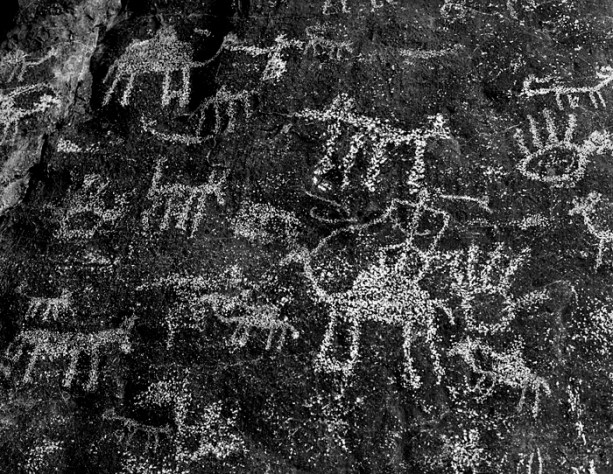
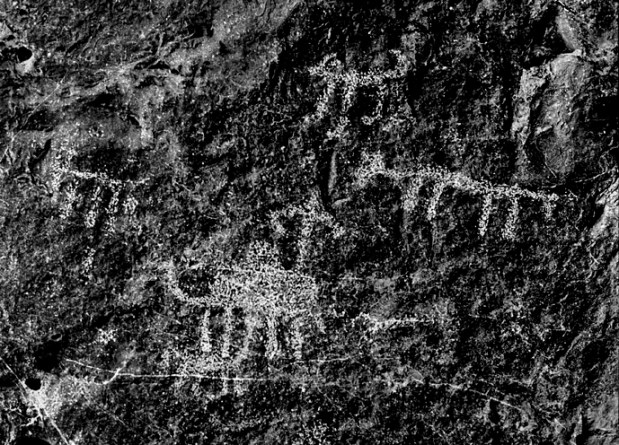
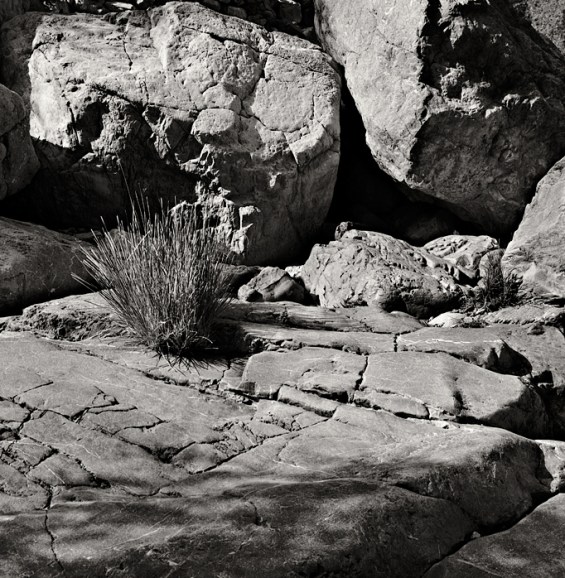
Hasat Bani Salt in the al-Zahirah Province of Oman.

Anyone interested in more information about the rock carvings depicted in the previous three images can look at this link.

archiv.ub.uni-heidelberg.de/propylaeumdok

when you open the link Click on:  Dokument 1 .pdf (1.455 KB) – it is in English….

For those that have the books, it can be found under: Sacred places in Ancient Oman. Journal of Oman Studies 11: 133-138; Yule, P., 2001. The Hasat Bani Salt in the al-Zahirah Province of the Sultanate of Oman.

Hasat Bani Salt or (Hasat Bin Sult).

Hasat Bani Salt or (Hasat Bin Sult).

A  block of limestone near Al Hamra; which has four near life-size human figures depicted in relief on its main face, these having been hammered out of the rock.

Age is not certain, but pre-Islamic and probably in excess of 3000 years old.

It has been disfigured at its base by graffiti! Terrible, because it is one of the most important archaeological finds in this part of the Middle East.

The carvings were “found” in the 1970’s by Coleman, a geologist who made contributions to the understanding of local ophiolites. This is why the rock is known also as ‘Coleman’s rock’.

The rock is at:


Drawing taken from Yule.P 2001.


Micro-Nikkor 55mm f/2.8 AI-s lens.

Kodak – Tri-X 400 at ISO 320.

This was taken using my Micro-Nikkor 55mm f/2.8 AI-s lens on the F2SB camera.

A lens that I think can still be found ‘new’ but there are many excellent used items on the market, it is worth looking out for one in fine condition.
Takes 52mm filters, focuses down to 9″ or so at which point the image has a magnification of 1:2 and can be increased to 1:1 with the use of a PK13 extension ring; one of Nikon’s sharpest lenses.

An excellent optic for both general photography and close-up work; distortion correction remains virtually unchanged over the entire focusing range,
It seems to have a reputation for oil contamination of the aperture leaves, I know several people who have used one of these lenses and none has had this problem. But it may be worth using a bit of caution if buying used.

Fujifilm FinePix X100.

I never thought I would post a link that went to a Digital camera site but…..

Fuji has come up with a Digital Range Finder that could almost be designed for a photographer (note hint of sarcasm!)

It even has an ‘Optical viewfinder’ where did that come from – what a wonderful idea! Why has no one else thought of it? I must stop this sarcasm….

Yes I know that both Nikon and Canon have put such a view finder on one or two of their digital point & shoot cameras; but they always seem like an afterthought, so let us hope this one lives up to the hype.

finepix-x100

Nikon F2 SB.

The F2 was the second of a long line of Nikon F ‘professional’ 35 mm SLRs that began with the Nikon F (famous because of the many iconic images taken during the Vietnam war) and may have ended with the F6.

The Nikon F2 is an all-metal, mechanically controlled, manual focus SLR with manual exposure control; it was completely usable without batteries, as they were used for the meter only (2 SR76 silver button cells).

The F2’s interchangeable viewfinders also known as “heads” marked it out as a truly professional level SLR.

By providing updated heads every few years, Nippon Kogaku was able to introduce new versions of the F2 with the latest technology, but keep the same body in production until the end of 1980.

The F2 SB Photomic with the DP-3 head became available between 1976 and 1977. The DP-3 introduced three new innovations: a silicon photodiode light meter for faster and more accurate light readings, a five stage ‘centre-the-LED’ exposure control system using 3 LEDs (+/o/−) and an eyepiece blind.

The Nikon F2 was probably one of the best cameras ever produced and is still available today through the used market. A word of warning! This camera will give years of service but it is getting on in life and some ‘TLC’ will not go amiss for it to give of its best.

I was very pleased with what Sover Wong has done for mine and anyone contemplating a service would probably do no better than contact him and see what he has to offer. See link ‘F2 repair’.

F2 Repair.

Nakhal Fort.

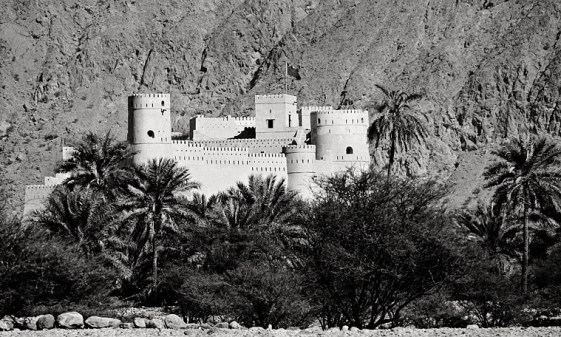
Nakhal Fort in the Batinah region has pre-Islamic origins, with major contributions by both the Ya’aruba and Al Bu Said dynasties.

In 1995 the fort was repaired; but up until then it was described as the ‘Black’ fort and that is what I saw on my first visit back in 1986. Even in its dilapidated state it was still an impressive building with dark grey almost black walls. Now it is a rather nice honey colour and is somehow  less ominous as it looks down on the surrounding area.

“bait al qufl” Jebel Harim.

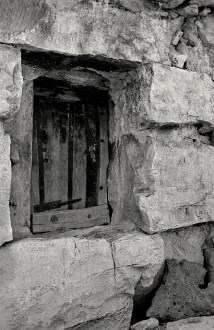
The photograph below shows the door of a building called a “bait al qufl” (house of locks) built for protection from the elements. The floor, a metre or so below ground, has raised stone slabs for eating, sleeping and storage. The recessed door has a double locking system and opens inwards, one does not get in without being asked!

When I first came across one of these while trekking on Jebel Harim; the door was not locked and the place seemed abandoned, so what a shock I had when pushing the door open and stepping from bright sunshine into the dark interior – I fell in! Luckily my camera was on a tripod and not in my hands.

Equipment and paper long gone.

A little information about the image below:- ‘as the sun goes down’ taken on Jebel Harim.

I used my Nikon F4 and a very good Tokin AT-X 35 to 70 – F2.8 manual focus zoom lens; extremely sharp and very well made. The lens is constructed to a very high quality which was typical of this type of lens. None of the plastic parts and ‘f’ stop ring being left off that one finds these days.

I am afraid that scanning and a monitor screen has not produced the effect that I was trying to get when I made this photograph, but hay ho….

Due to the abundance of small stones and rather harsh evening sun; the whole area took on what I can only describe as almost ‘Pointillism’ and that is what I tried to capture.

Ilford FP4 @ my preferred ISO of 100 , developed in Kodak Microdol-X at 1+3, printed on a now sadly gone Ilford Matt RC paper using Dektol 1+2.

This was and is the only paper that I have managed to use that gave me the visualisation that I required.

The Nikon 35Ti.

I used my Nikon 35Ti camera for the last three images taken at Wadi Bani Habib.

This is a nice small point & shoot (with a little more tucked up its sleeve) that I got for when I really want to go light, while out trekking.

The Nikon 35Ti from 1993 was the first Nikon compact camera that had a Nikkor (not “Nikon”) f2.8 lens

Nikon designed a unique, matched needle gauge cluster which gives information that relates to picture taking control. Shutter speeds are 2 sec to 1/500 sec with an ISO range from 25-5000, autofocus employed 833 steps for precise focusing from 1.3′ to infinity or you can manual focus via a pre focus method. Available Exposure control is Programmed or Aperture priority AE manual.

All in a strong Titanium metal case.

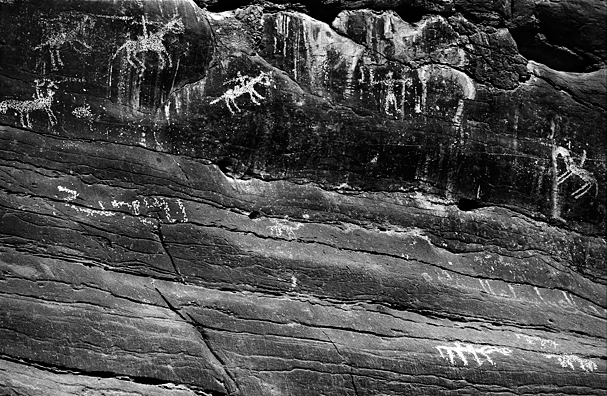
Rock Art of Oman.

There are numerous rock art sites found here in Oman, but it would seem that its cultural significance is lost on most of the indigenous population.

A search of the internet finds very little on the subject and The Journal of Oman studies has only the odd reference.

It can be rather difficult dating it; but given the subject matter, I would think using examples found in such places as Saudi Arabia and other areas of the Middle East; dating should not be outside the bounds of possibility.

Another reason is that it can be rather hard finding it; given that most of the really old examples are in places that are well off the beaten track. This may be a good thing though, because I have found some sites that have had ‘graffiti’ added (The only description I can come up with when I see ‘Kilroy’ was here or at least the Arabic/tourist equivalent) to pictograms that are maybe hundreds of years old.

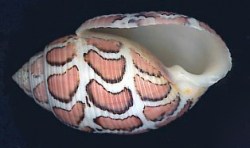
“Acteon Eloiseae”

“Acteon Eloiseae”

I have three of these shells – all taken from ‘Hermit crabs’ I even found the crabs another type of shell and encouraged them to move. Sad I know, but in the interest of conservation and because a number of irresponsible people have taken live shells; I was not about to do the same.

Masirah Island.

Masirah (مصيرة) is an Indian Ocean island off the east coast of Oman which is 95 km long and approximately 12 to 14 km wide. I know because I ran it as part of a ten man relay team on the 27th April 1990. I think this was the first time anyone was mad enough to do it! We followed a track that ran very close to the sea for most of the route, making the whole run more than 160kms……

The rugged terrain of the island and surrounding coastline has led to the appearance of many wrecks.

There is a quite  famous shell called “Acteon Eloiseae” which is found on one beach area of the island only – a place called Sur Masirah which is approximately half way down the west side .

It was first identified by Dr Bosch and his wife Eloise; unfortunately it has become rather a desired shell by visitors, some of whom are not particular about conservancy.

Four species of turtle use Masirah’s beaches for nesting, with the loggerhead turtle population being the most important of these, and probably the most important nesting area in the entire world.

The birdlife of Masirah is mainly made up of species from the Arabian Peninsula, but it is also a haven for some migratory species. Located at the crossroads of some important migration routes, Masirah can attract birds from India, Pakistan, Africa and wintering birds from as far north as Siberia.

Archaeological discoveries on the island indicate habitation going back at least four thousand years. Areas for the production of copper in the prehistoric period have been found; with sites dated to the second millennium, first millennium and probably the Late Iron Age.

Shell middens and flint artefacts used for scraping the shells can be found at a number of sites.

Hilary Hahn.

For anyone that has wondered what Hilary Hahn has to do with photography and why I would put her site on my blogroll – they have never heard her play Bach and Stravinsky.

Other than that nothing…….

Her interpretation of Bach’s Concerto for violin is simply superb. She plays without pretension and has an intuitive musical understanding that is rarely seen.

Oh and she does not use excessive vibrato! The Barber Violin Concerto is maybe the exception; although she does generally try to control it. But double stops with two fingers can be interesting if one is trying to follow such things as fingering – don’t ask I just have a long time interest in the violin.

The Master Photographer’s Toning Book.

Occasionally a photography book comes on to the market that becomes a ‘must have’ and this is one of them.

The Master Photographer’s Toning Book: by Tim Rudman.

Unfortunately for the buyer it proved so popular that it has sold out and the odd copy that does become available can reach the dizzy price of $1000. And no, I did not add an extra zero by mistake.

Fortunately Tim has decided to reprint the book himself at a far more affordable price. So if it is maybe of interest then visit the link below, or just go and look at his photography – excellent.

http://timrudman.com/content/toning-book-reprint