Film Enlargers.

Enlarger No1

For a change, I thought I would give some information about the two enlargers I use.

For negatives from 6×9, 6×7, 6×6, 6×4.5 and 24×36:

Meopta magnifax 4:

In comparison with many other enlargers on the market this was one of the best in terms of value for money, quality and especially handling. It may look rather functional but that actually is one of its virtues, it does the job with the minimum of fuss.
It has an interesting addition in the form of ‘split-line’ focusing which actually works very well. Especially for a test print when focusing is not needed at grain level. You just pull out the carrier halfway and see two lines, join them using the focus knob to get one line and everything is sharp. Another good feature is a neutral density filter which is good for reducing the light output, letting one use the optimum ‘ f ‘  stop on the enlarging lens.

It has a choice of three heads, B&W condenser, a Meograde for variable contrast paper and the colour head 3 for all film types, this is the one I use. There are two (more if you include specialist light sources) generally used types of light output, Condenser and Diffuser, I prefer the Diffuser as it uses a ground-glass screen in the light path producing a nice even light across the negative; condenser enlargers achieve this using condenser lenses. There is a debate about how each type produces different contrast levels for a given negative, but I personally have never noticed much difference.

The late Barry Thornton in his book ‘Elements: The Making of Fine Monochrome Prints’ 1993. mentioned that it was one enlarger he never regretted buying for both professional & personal use. As I had enjoyed reading the book and found it informative and entertaining; I looked out for one of these enlargers. Never in almost 20 years has it let me down.
For negatives from 6×6, 6×4.5 and 24×36:

Durst M605:

Although this enlarger was built with the amateur market in mind, the Durst M605 is a strong, precise all metal design, built with the highest standards as was all their equipment.

It accepts negatives up to 6 x 6 cm and although the column is not tall, it is sufficient for making 12×16″ prints. A dedicated extension arm allows one to make 16×20″ prints but this needed to be purchased as a separate item. 😦
The enlarger head is of the diffuser type, the advantage of the diffuser head is the possibility of quickly switching from 35mm to 6×6 by just moving a lever and changing the lens of course. Enlarging lenses are a subject all of their own as the quality varies considerably and the most expensive are not always the best.

The other important feature you need is a glass negative carrier which both have. Don’t be confused by anyone telling you that glassless carriers are easier. Glass carriers require a little more dusting, but they hold negatives much flatter and that produces sharper images, especially with 6×6 or above. Plain glass is good, anti-Newton glass better; it avoids seeing the interference rings (Newton`s rings) produced when two flat optical surfaces are in close proximity, as they create interference effects associated with residual Fresnel reflection.

Both of these enlargers can be found on the used listings and at the moment are quite cheap. That may change in the very near future as more people take up or return to traditional film photography (as is the case with vinyl for example) and they said that was dead as well !
Bats !

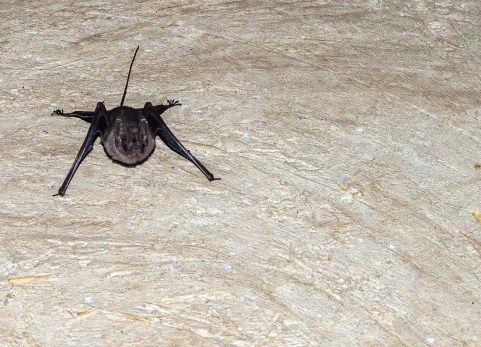
Small Bat bahla fortOne of a very large number of small Bats in Bahla Fort.

I don’t think I mentioned Bats from last weekends visit to Bahla Fort  🙂

What with the talk of Jinns and getting a little lost; there  were a great number of bats, especially in the darker corners of the fort. A  feeling of  Transylvania about the place…..

I was determined to get a picture of one, but easier said than done ! So excuse the quality, it is a miracle of Nikon that I got one at all. The body size was about 10cm and the room needed to be dark for them to land, otherwise they were zipping round getting excited about being disturbed.

So how did I manage this image without giving them more stress?

Camera set on Auto exposure, Aperture-priority AE, 1/60 sec, f/8, ISO 200 with built-in flash set very low & using my Tokina 35-70 f2.8 lens. I stood in the room until my eyes adjusted (zone focused my lens) then waited.

Bahla fort.

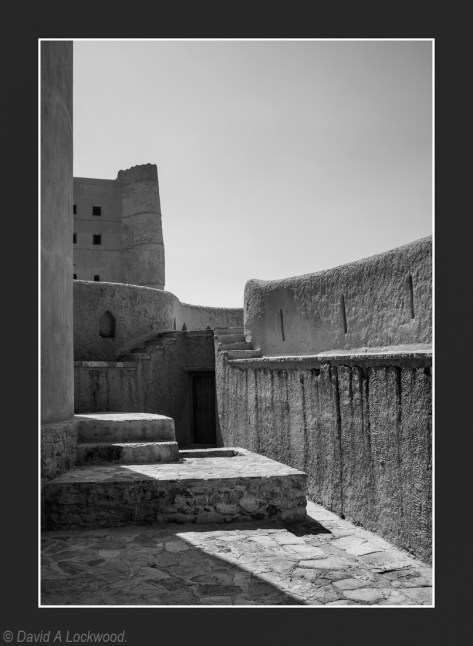
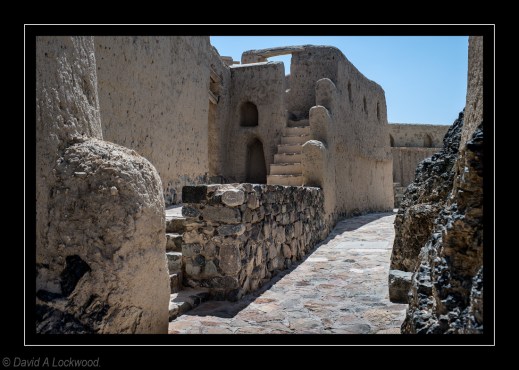
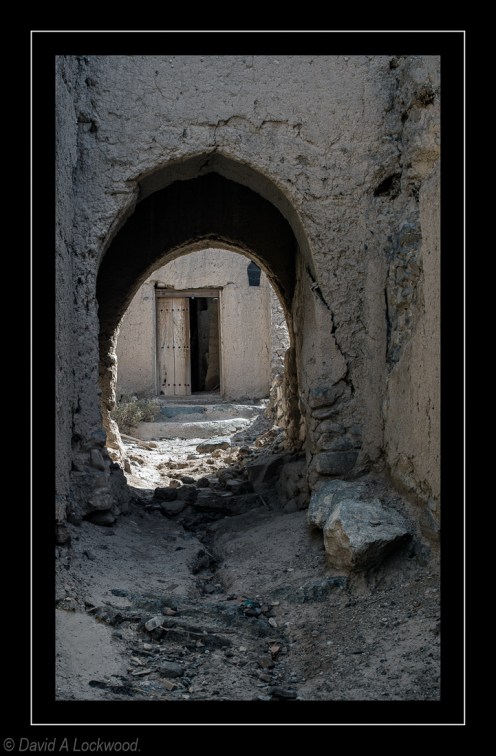
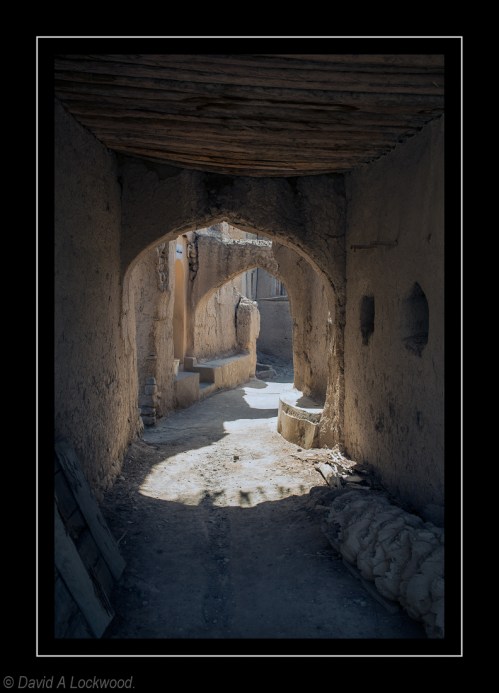
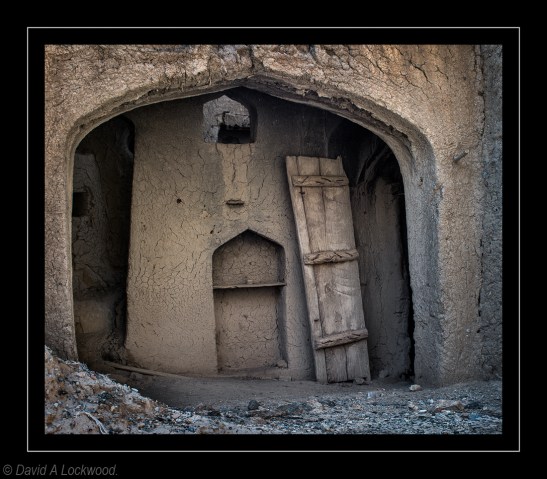
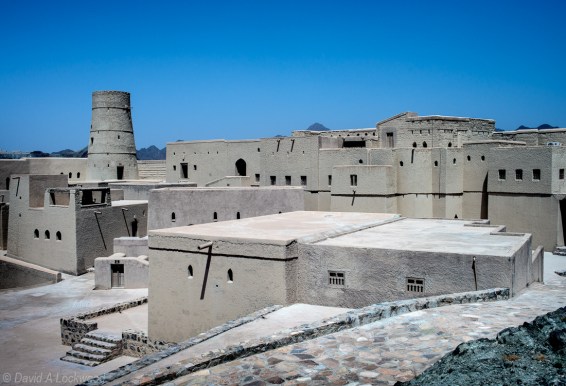
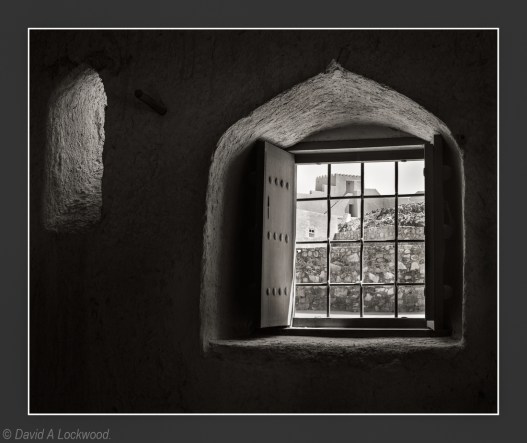
Bahla Fort

I have been trying to get a visit for aeons, but always closed – beginning to think it was a conspiracy by the jinns that are said to occupy the place….


Bahla fort and settlement owed its prosperity to the Banu Nebhan tribe who had prominence from the 12th to the end of the 15th century and made Bahla their capital. From here they were able to established relationships with other tribal groups of the interior. Bahla was the centre of Ibadism (a branch of Islam), on which the ancient Omani Imamates were based.
The fort became a UNESCO World Heritage Site in 1987. It was included on the List of World Heritage in Danger from 1988 and restoration work began in the 1990s. The fort with its walls and towers of mud brick on stone foundations along with the wall enclosed oasis, is understood to be the third largest example in the world. It’s a labyrinth of floors, doors and rooms; without a guide, needs careful thought as to which way the entrance was, when time for departure. 🙂
The town is well known for its pottery and although not mentioned unless one asks, its magic, in fact its second name is “Madinat Al Sehr”(the City of Magic). All part of Oman’s unwritten history of tradition and folklore.

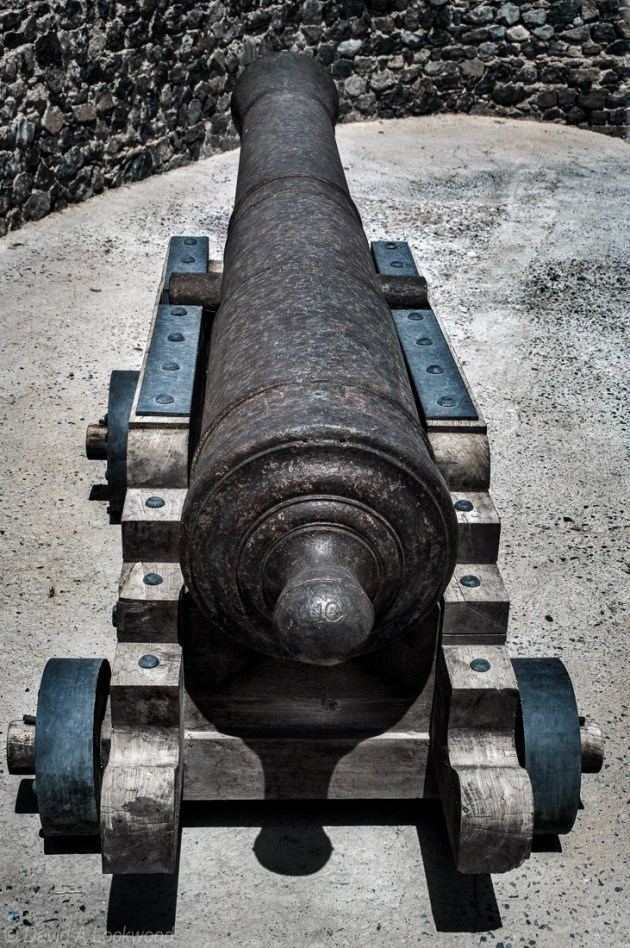
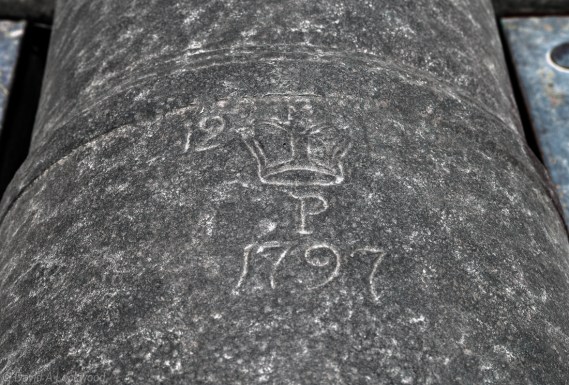
Cannon found at the entrance.

Cannon no4

Cannon no3

Cannon inscriptionOld !

Considerations on Representative Government.

Considerations on Representative Government. by John Stuart Mill .

P.S. this book can be got quite legally for free (the wonders of the internet ) see link below:  if  by chance you are interested.

http://www2.hn.psu.edu/faculty/jmanis/jsmill/considerations.pdf

Maybe this should be compulsory reading for certain members of society !!

On page 200 he says………

“Until mankind in general are of opinion with Plato that the proper person to be entrusted with power is the person most unwilling to accept it.”

Referring to this paragraph from Plato, Republic:

The good are not willing to rule either for the sake of money or of honour. They do not wish to collect pay openly for their service of rule and be styled hirelings nor to take it by stealth from their office and be called thieves, nor yet for the sake of honour, for they are not covetous of honour. So there must be imposed some compulsion and penalty to constrain them to rule if they are to consent to hold office. That is perhaps why to seek office oneself and not await compulsion is thought disgraceful. But the chief penalty is to be governed by someone worse if a man will not himself hold office and rule. It is from fear of this, as it appears to me, that the better sort hold office when they do, and then they go to it not in the expectation of enjoyment nor as to a good thing, but as to a necessary evil and because they are unable to turn it over to better men than themselves or to their like. For we may venture to say that, if there should be a city of good men only, immunity from office-holding would be as eagerly contended for as office is now.

No country has a monopoly on truth no matter how big they are.

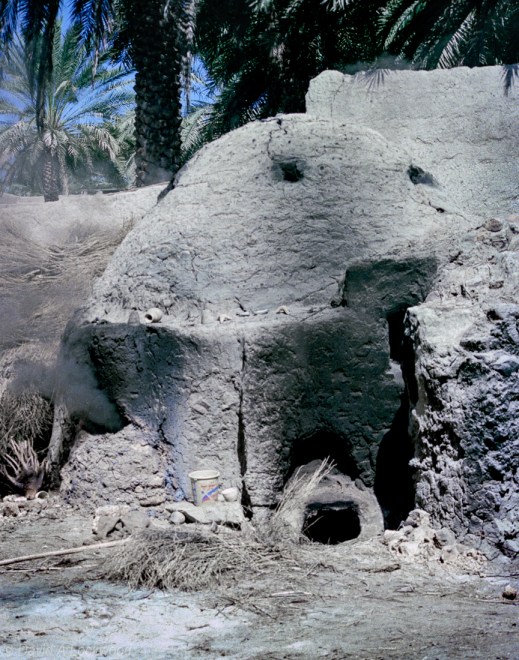
Bahla pot maker from the early 90’s.


Found these – made in the very early 90’s I think (on Kodak Gold) A Potter from Bahla; I wonder what has happened to him in the intervening years?

Almost certainly taken with a Nikon AF401 and 35 to 70 mm zoom lens, shop processed.

Bahla

Bahla No2C41 negatives scanned with a Plustek 7600i and cleaned up in P/S Cs6 (they needed it !) The local shop did not take as much care as one would expect in more modern places. The negatives had faded (old chemicals used probably)  and the colour had shifted a bit.

Are you sure that the world you see in colour is the same one I see?

I always suspected there was more to the film Matrix than meets the eye………

Are you sure that the world you see in colour is the same one I see; your answer is probably yes. In reality one should probably so no!
The more science begins to understand the connection between what we see as our perception of reality, particularly that which is developed through language and culture. The less certain it is that we all see the world in the same way. For example, there is a tribe in Namibia called the Himba who have fewer words for various shades of colour than English-speaking people’s; they didn’t need them. There are certain colours they cannot see and it is not colour blindness. They just do not have a word in their language that describes that colour so the brain does not see it. Give them a colour wheel containing a uniform set of colour patches but include one colour they do not have a word for; they will not distinguish this different colour from the rest. Hard to believe but has been demonstrated through independent testing; colour and language are inextricably combined. Remember, a child does not fully see colour until it is several weeks old and then learns through language to differentiate colours.
One of the things most artists learn quite quickly is an understanding of the colour wheel and complimentary colours. The other is, where dark and light should be perceived within an image and how it is interpreted by the viewer. Unfortunately, this can have some unexpected consequences.
For photography this can be manifest in an undesirable magenta cast with certain ink and paper combinations under differing light. For traditional gelatine silver papers it showed as a green cast on fibre papers, which needed selenium toning or a change of developer to remove it. Both problems could be removed with careful consideration of the lighting used when viewing the image.
J M W Turner exploited the play of light and human perception of its qualities with great success in a lot of his painting. The Morning after the Deluge c. 1843 is a fine example. He utilised his understanding of colour to create drama and depth within this painting. Strip away that colour and all one is left with is a bland canvas, devoid of shadows and subtle shades of light.
Black & White photography removes the distraction and interpretation of colour and allows the brain to concentrate on detail. Which is why a lot of the best war photography is in B&W; it focuses the mind on the subject matter and avoids the distraction of colour perception. What do I mean by that; take the popularity of HDR imaging, it is not reality and can be quite disturbing for some. So my first decision has been, do I like the colour and if not, then the image gets ignored, no matter how good it may have been. The impact the photographer was trying to impart has instantly been lost, I don’t like the colour so I ignore the picture.
This is not to say that B&W does not have its problems, more so these days with the advent of digital and screen viewing. One of the things I hate is black shadows and glowing whites, E6 slide film wrongly exposed gave this with a vengeance. Bad printing could give what was known as the ‘soot & chalk’ look, hence the phrase – expose for the shadows and develop for the high lights. Unfortunately for people like me who are somewhat challenged when it comes to scanning; a negative that prints well, does not always scan well.
If you have been kind and patient enough to get here. Please make more time and watch the following YouTube video, which will demonstrate that what one sees is not always reality. It is but an interpretation, given by a particular set of circumstances.

I know it is yet another long one – sorry but the world does not revolve around sound bites…..


I digress again – Tea this time.

Tea.

I don’t always drink Guinness or Malt Whisky……….. ho and Whisky is the real drink, anything with an ‘e’ in it is a mere reflection 🙂

As it is St George’s Day and William Shakespeare 450th birthday, I thought I would celebrate with a nice afternoon cup of tea – an undeniably English habit.

Teas from China:

Oolong is one of my favourites; I never drink tea from the Indian subcontinent unless a polite refusal is inappropriate, as I find the stuff rather strong and bitter for my taste.
The one thing about high quality Oolong tea is that it can and should be steeped several times from the same leaves; unlike a lot of other teas, it improves with re-brewing.
The best way of doing this is with a measured amount of water, so that the leaves are drained and fresh water used for the next brew. Never let a pot of this stuff stand half full otherwise the tea will become stewed and you might as well have used cheap tea bags! Another point worth mentioning is, use fresh water that has not reached boiling point, otherwise the tea will lose its flavour.
It is best without milk and never sugar (a little honey if required) the light Oolongs have a very subtle sweetness so no real need for more.
There seems to be three main varieties of this tea, going from sweet honey through woody or earthy and then green and fresh tasting.

The other tea I love!! Is Lapsang Souchong:

This tea has a smoky flavour like a bottle of Laphroaig Single Malt whisky; the good stuff gets gently smoked in small batches over wood fires. A subtle and enjoyable drink, but like Laphroaig, not everyone’s taste in fine teas.
It can benefit from milk if so desired and the water is boiled before brewing. Another that can have a number of brews before the leaves are thrown away (the good stuff that is).

All I need now is some scones with strawberry jam and clotted cream (I should be so lucky – here in Oman) one can always dream………


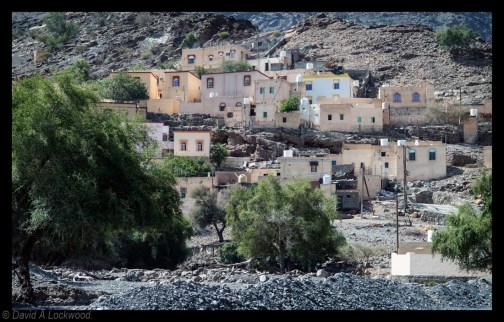
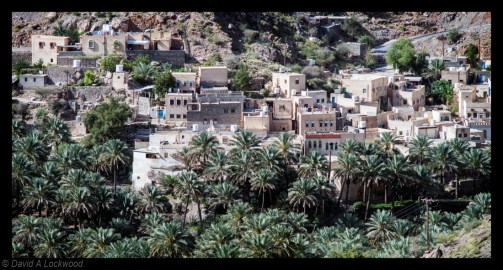
Three different villages in Wadi Bani Kharus.

Hidden village - Wadi Bani Kharus

Typical Omani Village No2

Typical Omani VillageThe white tower like structures on some of the roofs are water containers: a truck arrives every couple of days with a delivery.

In the past, water was obtained the hard way!  either a dug well or mountain run-off,  a small wall would be constructed near a fissure in the rock and the water trapped for later use.

With the construction of roads (rather than Donkey tracks)  along with electricity: life has become a lot less arduous.

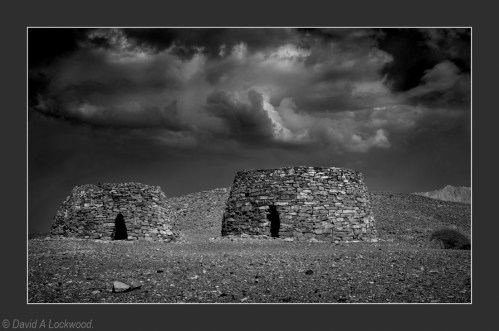
Necropolis of Bat.

Tombs near Bat No2

This is what UNESCO say about these tombs:

The zone encompassing the settlement and necropolis of Bat is the most complete and best-known site of the 3rd millennium BC. In a restricted, coherent space, the necropolis of Bat bears characteristic and unique witness to the evolution of funeral practices during the first Bronze Age in the Oman peninsula.

Historical sources recount that the country of Magan was the principal extraction centre for copper, which was exported even to far-away Mesopotamia, as early as about 3000 BC. The appearance of a more strictly hierarchical social organization (as attested to both in the settlements, where circular defensive structures contrast with rectangular houses, and in the necropolis, where the arrangement of funerary space is more complex) goes hand in hand with higher living standards and social changes linked to a trade economy.

The protohistoric site extends north of the village and palm grove of Bat, when excavation began in 1972; it includes a settlement and a necropolis from the 3rd millennium BC. In the settlement zone, north of the confluence of a small waterway and Wadi al Hijr, there are five stone ‘towers’, structures that are very representative of the first Bronze Age in the Oman peninsula. One of the towers has been entirely excavated and it has been determined that it was built between 2595 BC and 2465 BC. At the level of the substructures, the plan of the tower features a series of exterior surface projections and two rows of parallel rooms on either side of a large platform in masonry with a well in the centre.

From the tower, which serves as the site’s reference point, can be distinguished immediately to the east on the slope a series of rectangular houses with central courts and, to the north, a vast necropolis that can be divided into two distinct groups. The first group is located at the top of the rocky slope. Its drystone tombs (some of which date from the 4th millennium, although in some cases they may have subsequently been modified) are scattered along the path from Bat to Al Wahrah.

The much more densely concentrated second group extends over rice terraces south-east of the wadi and includes more than 100 drystone ‘beehive’ tombs, which tend to be organized according to an overall plan. The most ancient ones are to the north. They have only one entrance and one funerary chamber and were a collective burial-place for a small number of dead. Towards the south, the sepulchres become more monumental. They have two entrances which open on to two and sometimes four funerary chambers and were intended for larger numbers of dead.

The settlement and necropolis zones of Bat form a coherent and representative group with two neighbouring contemporary archaeological sites: the tower of Al-Khutm, 2 km west of Bat, and the group of beehive tombs of Qubur Juhhal at Al-Ayn, 22 km east-south-east of Bat. The 21 tombs from the 3rd millennium, aligned on a rocky crest that stands out in the superb mountainous landscape of Jebel Misht to the north, are in a remarkable state of preservation. They have not been excavated and constitute an obviously interesting archaeological reserve.

The site can be found near Ibri (عبري‎) a city in the region Az Zahirah, northwest Oman.