
 Half open door & windows,
Tag: Tokina 35-70 f2.8 AIS AT-X
Doors within doors.
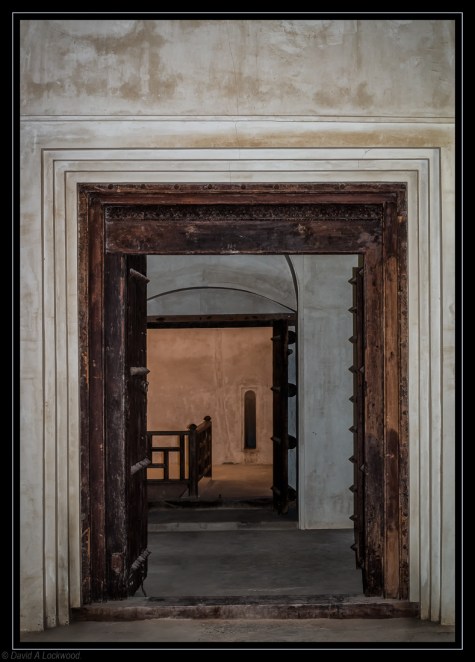 D800 with Tokina 35-70 f2.8 AI.s AT-X lens.
Bent lines & buildings constructed using traditional methods…… Plumb-bobs have a lot to answer for
when making photographs of architecture built by eye.
Another from my Flower series.
 A Single flower….
Nikon F3 with Tokina 35-70 f2.8 AT-x lens.
Shadows with Decorative window.
 Shadows with Decorative window.
Nikon F4 – Kodak Plus-x @ asa 100.
Musandam.
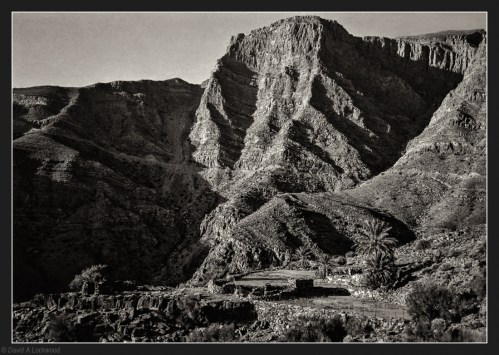 Nikon F4 with Tokina 35-70 f2.8 AIS AT-X.
This is from a negative that I saved after a whole file of them got wet when my house was inundated several years ago 😦
Thankfully a good soak in Photo-flo solution was able to save a good number of them. Although as you can see, there is some damage in the sky area as this was made on Ilford XP2 which is a dye cloud film, so not as hardy.
Most were images I had taken when I was working in the Musandam.
A little bit of history as to why Oman is split into three parts – Oman, Madha & The Musandam.
It goes back to the formation of the UAE in 1971. Prior to this, the area was little more than a collection of sheikhdoms (unlike Oman by this time) with not much in the way of formalised government. It was administered by the British as Oman & the Trucial States.
When the British withdrew from the region a decision was made to form the Trucial States into a single country, the United Arab Emirates. As you can probably imagine, there was a great deal of debate over which parts were owned by which sheikh.
Some areas were easy but were there was the possibility of dispute; the British simply asked the villagers which sheikh they owed their allegiance to. Madha decided to pledge their allegiance to Oman, so they become Omani.
With regards to Musandam; this has significant strategic importance as, with Iran, it allows control over the Straits of Hormuz. Hence Oman was able to maintain control of The Musandam in these negotiations, but didn’t win the rest of the coast, which is why Musandam is also not connected to the rest of Oman.
Plastic bag.
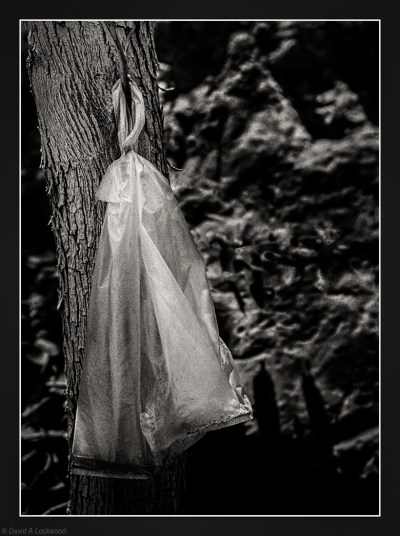 Nikon F2sb with Tokina 35-70 f2.8 Ais AT-x lens. On Fuji Neopan 400 pushed two stops.
Quite often find (abandoned ?) bags hanging from a tree branch – especially in the middle of nowhere….
There never seems anything in them.
Crooked clasp.
 Nikon F2sb with Tokina 35-70 f2.8 lens – made on Kodak Tri-x.
Old pot & plant.
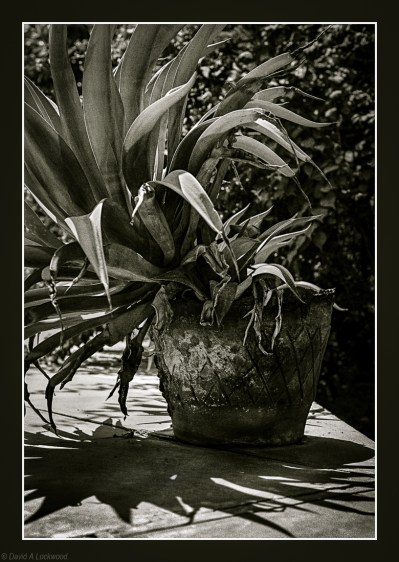 Nikon F3 with Tokina 35-70 f2.8 Ais AT-X lens. Kodak T-Max 400 @ iso 320.
Another from my tinted flower series.
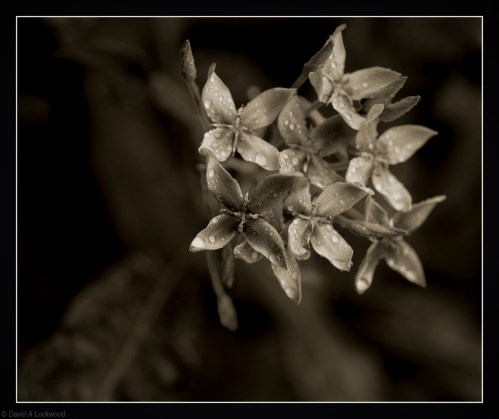 Nikon D800 with Tokina 35-70 f2.8 Ais AT-X lens.
Another from the flower series.
Wadi Rocks.
 Wadi rocks.
Nikon F2Sb with Tokina 35-70 f2.8 Ais AT-x lens. made on T-max 100 film.
Detritus.
 Detritus.
Lone Tomb – Salut.

Salut – Shrine.
 The Greek looking shrine – Salut.
An incongruous match.
 As could be seen from an earlier image – quite a climb getting here: definitely worth the effort.
Friendly tree.
 My friendly tree 🙂
Date Storage – Al Hazm Fort.
 Nikon D800 at ISO 6400. Tokina 35-70 f2.8 Ais AT-X lens.
A Date storage area on the ground floor of Al Hazm fort.
The raised channels that can be seen in the image above were used for storing Hessian type sacks of dates. They were stacked one on top of the other and as the juice was forced out of the lower sacks, it ran through the channels into a catchment area.
This juice had a number of uses; a very nutritious food, medicinal qualities both internal as medicine & external in the form of salves, can be used as a sweetener like honey and I am sure in the case of Al Hazm Fort, a military use! Boiled and poured through the murder holes above entrances.
From that well-known on-line encyclopædia.
Dates have been a staple food of the Middle East and the Indus Valley for thousands of years. They are believed to have originated around Iraq, and have been cultivated since ancient times from Mesopotamia to prehistoric Egypt, possibly as early as 4000 BCE. The Ancient Egyptians used the fruits to make date wine, and ate them at harvest. There is archaeological evidence of date cultivation in eastern Arabia in 6000 BCE. (Alvarez-Mon 2006).
There is also archaeological evidence of date cultivation in Mehrgarh around 7000 BCE, a Neolithic civilization in what is now western Pakistan. Evidence of cultivation is continually found throughout later civilizations in the Indus Valley, including the Harappan period 2600 to 1900 BCE.
In later times, traders spread dates around South West Asia, northern Africa, and Spain. Dates were introduced into Mexico and California by the Spaniards in 1765, around Mission San Ignacio.
Fossil records show that the date palm has existed for at least 50 million years.
Nakhal Fort.
 Nakhal Fort.
Off-Road from Bani Auf.
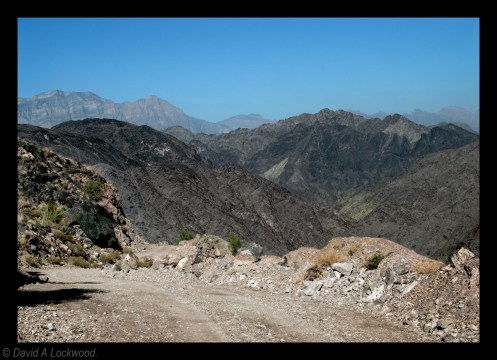 Some of the easier off-road driving in Oman – looking toward Wadi Bani Auf.
The Devil’s finger jebel akhdar.
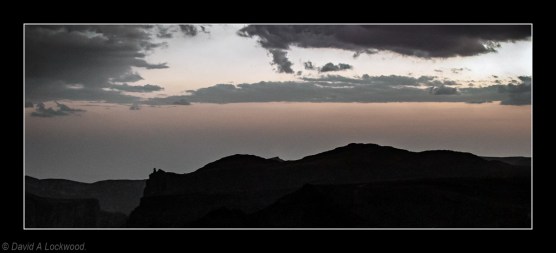 The setting sun has just dropped behind the range of hills – last night on Jebel Akhdar: the sticky up bit a third of the way in from the left is known as The Devil’s finger.
I have tried along with some friends, to find a path that gets me onto this prominent feature – other than the very long hike from right to left along the range of mountains. Unfortunately without success as yet; it’s the long way or not at all.
It has been raining for the last few evenings on this range of mountains, hence the dark clouds.
Muttrah.
Muttrah – a visit made because I should have gone into the jebel but was lazy, hit the alarm off button and then overslept…………
The place is only like this early in the morning, by later in the day it will be a busy crowded area full of merchants, customers and these days, tourists and one cannot move!
Muttrah or Al Dhalam (Darkness) Souk in probably one of the oldest market places in this part of the Middle East.
The city was walled, with two gates; Bab Kabir & Bab Mathaib, they were always guarded & by royal decree, all camels were left outside the gates, thus avoiding traffic jams ! 🙂 the best way in & out was boat.
Trade has gone on here for centuries with everything from dates, dried fish, limes, spices, coffee, cloth, and luxuries such as gold and silver: the list today is endless and all cards taken thank you very much…..!
In the past payment would be mostly the Maria Theresa silver thaler (first minted in 1751) and used right upto the beginning of the 1970’s. For larger transaction gold, along with the gradual introduction of all major middle eastern currencies and of course the Indian rupee.
The method of transaction/transportation tax was complicated; it depended on the item, quantity, quality and production area – actually it seems that at some time or other, just about anything one could dream up to justify tax, was !
Muttrah had the first hospital in the whole country…….. set-up initially in Muscat but almost immediately moved to Muttrah in 1893 ( a mission hospital by the Dutch Reform Church of America) it was fully functioning by 1909 and only closed once during the First World War.
There are many fine old merchants’ houses and at least one area (the Liwatiya quarter) that as a stranger one is always looked on with some suspicion even today: not in any hostile way, but if not accompanied by a resident one is usually kindly asked to leave.
From Wiki:
The size of the Al-Lawati population cannot be determined precisely, but is estimated to be approximately 80,000 people Most Lawatis reside in Muttrah, but some live on the coast of Al-Batina. Some Lawati families reside elsewhere in the Persian Gulf region such as U.A.E, Qatar, Bahrain and Kuwait.
Traditionally, Al-Lawatia have been known as prominent merchants on the coasts of Muttrah which lies 2 kilometers from Muscat. They have worked in the incense, jewelry and clothes business as well as in general trade. The community occupies a gated quarter of Muttrah known as Sur al-Lawatia. The quarter still boasts attractive houses with a unique Islamic architectural view and a large mosque known as Al-Rasul Al-Aadam Mosque or The Greatest Prophets Mosque.. The Sur has seen a major exodus in recent decades as Lawatis have moved to more modern neighbourhoods as a result of increasing development, the availability of facilities and growing wealth and business of the community.
 All made with Nikon D200 & Tokina 35-70 f2.8 Ais AT-x lens.
Click on any image below for gallery view.


Hummm – not to be seen before eating the food being cooked here.


Tanuf Trees.
 More trees 🙂
Jebel Track.
 Nikon F4 & Tokina 35-70 f2.8 AIS AT-X, made on Ilford fp4. Negative slightly diffused with Vaseline on old filter.
Cannon tower Al hazm fort.
 This column has a lot of work put into the decoration for what is essentially a support.
Spent ages trying to get a position that would show both sides and centralise the arch: gave up !
Al Hazm Fort Interior.
 One of my last before I disappear for a month: thanks for all the comments and ‘likes’ since I last stepped off the world 🙂
Hopefully everyone has enjoyed my excursions around the various Forts.
Roof top Al Hazm Fort.
 Busy weekend as this was my last trip before I step-off the planet for a couple of days short of a month (holiday time soon 🙂 ) anyway it was 49 degrees C when this series was taken……. enough is enough: mad dogs & Englishmen come to mind !
 David A Lockwood