
Geological wonders in Oman made by the Geological Society of Oman in 2012.
Category: Information.
Retouching prints.
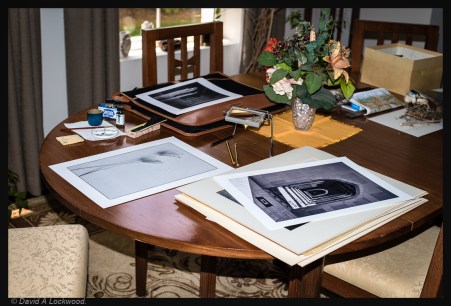 Retouching prints.
As you can see, I have a bad habit of taking over the dinning room table when retouching photographs: side light from the windows is good (my excuse anyway) which is a must.
As most of my work is on matte fibre papers (even my inkjet prints are matte papers mostly) I can use a number of different spotting mediums.
Spotone dyes are (were) the best IMHO but Marshalls are now the only archival liquid dye I know of. Two other methods can be used with good results: a range of artist quality pencils & the Edward Weston use of ink & gum arabic. For this I use Japanese ink stick and varying amounts of the gum arabic; depending on how glossy the paper surface is.
Ink jet prints will sometimes get the odd white or pale spot that went unnoticed on the screen (especially in high-key images) they can be retouched using the same methods used for fibre prints. Yes I know I could just reprint, but sometimes I won’t notice the fault for several days.
It could also be that I have developed a parsimonious reason; the cost of Ilford fibre paper is not cheap now, neither is good inkjet paper. If the retouching is done well enough, it will never be noticed when the print is behind glass.
Two things from the above: a tip from my wife (an artist who uses both watercolour & oils) is, look at the image upside down in a mirror. The other being, leave a print where you can see it on a daily basis: both remove the image from the minds eye, one then looks at it with a fresh mind-set.
New lens – Nikkor 25-50mm f4 zoom.
 Nikkor Ai 25-50mm f4.
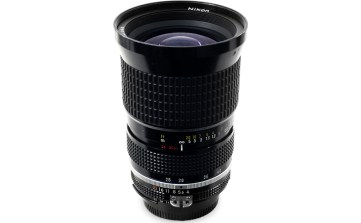
A new addition to my manual focus Nikkor collection: The Nikkor Ai 25-50 f4 zoom lens.
Click lens image below for Nikon site.
As of May 2017: Nikon seems to have taken down their Nikkor 1001 Nights Tales – this is very sad because it had so much interesting information about the design and production of many lenses. I hope this is just for the duration of their 100th anniversary; it would be very short-sighted of them if it is gone for good.
Update 20 Aug 2017: it looks like all the tales ending with No.60 are back.
One of Nikon’s early professional zoom lenses, which should complement my ‘F’ camera quite nicely. This lens was manufactured in 1981 and by the end of that year was changed by Nikon to an Ai-s version. For some reason the second-hand price for the Ai-s version is more expensive than the Ai, there is no real reason for buying the later version unless one owns a Nikon FA camera, even then it is questionable as the internal construction of both lenses is exactly the same. All Ai / Ai-s lenses fit on every Nikon SLR camera, be they manual or AF with one caveat; some of the cheaper AF cameras will not meter with manual focus lenses (check your instruction manual). The only warning I would add here is ‘non Ai lenses’ made for the Nikon ‘F’ will damage most other cameras, with the exception of the F3, F4 & the Df !
See this link for camera compatibility: https://www.nikonians.org/reviews/nikon-slr-camera-and-lens-compatibility
This lens has some very nice qualities; although long discontinued, it is without colour aberrations and images are sharp from corner-to-corner, light fall-off being very low even wide open. It will attain peak sharpness at f/5.6 and holds well even when stopped down to f/16 which delivers very good results.
Looking forward to cooler weather 😎 so that I can get out & about with it fitted on both film and digital cameras.
WHY THE CROW LOOKED UP AT THE TREE.
A bit of unabashed advertising: I must take this opportunity and introduce my wife’s E.Book.
If you have children who like reading or being read to and enjoy animal adventures, then I am sure they would enjoy this book. If interested then click on the book cover for an Amazon link.

Three young animals meet after a very bad storm, in an ancient oak tree. A Siamese, a crow and squirrel. They become friends, until one of them with a sibling is taken to a new home by people who have never had cats before. The crow hearing the confused cries of his friends follows the car, thinking to rescue the Siamese kittens. At the journey’s end there is a stray tomcat lurking in a nearby hedge and nearly captures the crow. The stray is adopted by the humans and named Scarecrow.
Prior to this an older squirrel Twigleaf, fell into the river and got swept away, not far from the oak, which is his home.
There is open warfare between the Siamese kittens – Aqua and Tangsun her brother and the ginger tom, who misses his real family, recently returned from abroad. He had gone out within a few days and got lost in the storm, unable to smell his way back. The kittens new owners, cannot cope with the animosity, secretly preferring the tom, punish the Siamese. They become ill with parasites Scarecrow had picked up while he was a stray. Eventually Scarecrow and the kittens call a truce, the tom finds his old family and the Siamese escape, having all sorts of adventures manage to return to their mothers place just before a spring snow storm.
My Canon Pro9000 printer – update.
I am a very happy bunny………………………… 🙂
Just back from UK with a new print head and my printer is back up & running. It would seem that Canon were aware of problems with the original Pro9000 mk1 head; Pt No:- QY6-0055-000 and replaced it with a QY6-0076-000 which fits both the 9000 Mk1 & Mk2.
Amazon had Canon 0076 heads at about 98 pounds sterling, a lot less than was being asked for the original 0055 heads !!! so on advise I took the chance of buying one and lo & behold the printer is back fully serviceable.
Dead printer.
I have been using a Canon Pixma Pro9000 mk1 printer for a few years now: it has died…. Dead, given up the ghost – not a happy bunny !!!!
This printer has given sterling service & contrary to popular opinion, could produce some very nice B&W prints; provided a careful choice of paper was made and it was correctly profiled.
It would seem from the fault code indications that the print head has quit: every time I try doing a cleaning function it flashes ‘printer says no’. Gone through all the suggestions found on the trusty internet, no luck.
This printer looks like new and has always been kept covered when not in use; never had any problems, until now. I should have known, as the Canon agent tempted fate when I was buying new ink “gosh that’s an old printer, why not buy a new one” hummm.
What is it with electronic items these days, it’s a constant battle against new operating systems, drivers, spares & a barrage of being told new is better. Try telling that to my Nikon F or F2SB, new is not always better – just different & usually far more complicated when faced with scrolling through menus just because a function needs changing.
Things just never last: Don’t get me started on saving the planet “ You take the red pill – you stay in Wonderland, and I show you how deep the rabbit hole goes”
Gosh I am having a rant: probably because I have seen the price of a new print head; that is if a supplier has stock ! Two thirds of what the whole printer cost me. Ho well, there is always the Darkroom 🙂
I am on my way back home in a few days so will search and see what Canon UK says.
Update of article on Nikkor 43 to 86 Zoom.
See update in my previous Nikkor Zoom 43 to 86 post.
I have been doing a bit of research about the history of this lens and in an article (Linked) Nikon do acknowledge the limitations of this lens.
One of the really good things this lens has, is a very usable ‘Depth of Field‘ scale not seen on a lot of lenses today: In fact gone never to be seen again on the ‘G’ type….. !
Nikkor 43-86 AI zoom.
 Soft at the edges even at f8.
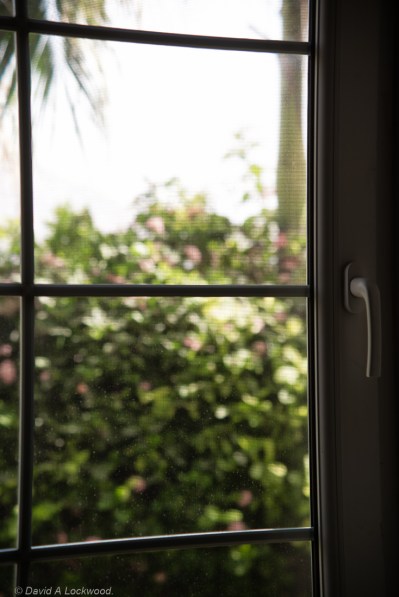 43-86 AIs Nikkor – 43mm @ f5.6.
Hummm…. Distortion is as bad as people say ! but for general use it’s probably ok – just no architectural images: I don’t want to hear it can be corrected in Lightroom !!! this is a film camera lens. Distortion like this is almost impossible to correct in the darkroom.
This is one of the last made, with a Sno: 1037665 which is an improved version. I wonder why Nikon thought it was ok, although the construction is of a very high standard which is missed with most of the AF lenses foisted on us these days.
P.S
Further reading about this lens.
In the Nikon article below, the operative word is “skilfully”
Nikon in their Nikkor – The Thousand and One Nights series (very interesting for those who use Nikon) do acknowledge its limitations : http://www.nikkor.com/story/0004/
“While there is no denying that its performance does not match that of its contemporary fixed focal length lenses or the latest zoom lenses, the 43-86mm instigated the development of the whole standard zoom lens genre, and deserves our esteem as the lens which more than any other popularised the use of zoom lenses by allowing the man on the street to experience the convenience and joys of zoom photography. It is still an eminently usable lens which if used skilfully can provide a unique and evocative quality unattainable with today’s lenses.
This lens, with its trademark array of coloured, engraved lines indicating depth of field over the zoom range decorating the lens barrel, is definitely one of the great lens to bear the Nikkor name”.
Tombs at Manal.

Behind the main enclosed site.


Building or platform remains.

Old & New.
Archæological site: opposite the Village of Manal.
There was some interest in this site around 2003 if I remember correctly; when a dig was carried out and most of the tombs were enclosed by a chain-link fence, but behind this on a tributary of the main wadi are more tombs.
I am not sure of the age: but what information I could find, listed it as an Iron-age site, although some of the tombs could be reused from an earlier date.
Converting an AF Nikkor lens for Nikon F/F2 metering.
 How to get an AF Nikkor 50mm f1.8 lens to engage with the metering system of a 1973 Nikon Ftn camera?
Easy ! If you can find the ‘Rabbits Ears’ as a spare part; a little difficult these days but not impossible, find a friendly camera repair shop.
Look at the F stop ring of most Nikon AF lenses (Pre ‘G’ type) there are two little dots at the f5.6 indication. These are where you will carefully drill two small holes, slightly smaller in diameter than the screws that should have come with the Rabbits Ears. They must be deep enough for the screws to be flush with the top of the ears pedestal, but no more…….. care is needed here ! I used some tape on the drill as an indication of the depth required and held the drill bit in my hand, not in any form of drilling machine.
Fit the Ears by placing a very small amount of contact adhesive on the base of the pedestal, then position with the step facing towards the front of the lens. The adhesive is only really needed so that fitting each screw is a little less fiddly; avoid over tightening these screws as they will have cut their own thread (if you got the diameter right) if not – don’t panic as a small amount of adhesive on the thread of each screw will take up the slack; but leave to dry for at least 24 hours before using the lens.
Voilà – an AF lens metering with an F & F2 camera system.
Nikon F – test film.
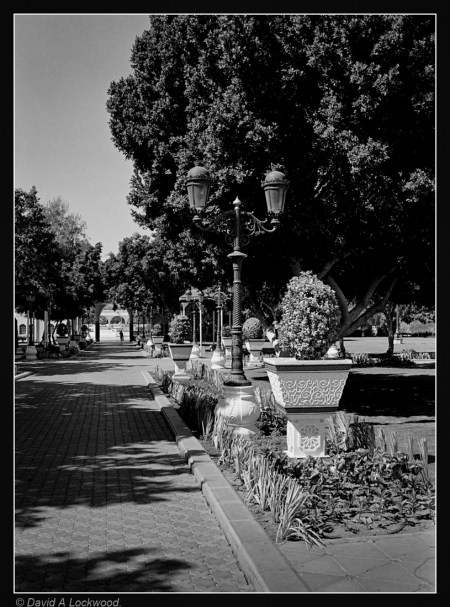 Fujifilm Neopan 400 @ box speed in Microdol-X 1+3. 22c for 15.5 mins with Kodak style agitation.
No filter, just a slight increase in contrast as compensation for image scan.
Ho & it was taken yesterday morning at Qurum Natural Park near Muscat – more of these later, as it is a lovely place for an
early morning walk & not a long drive from my house.
As an after thought for anyone interested: this was exposed using the camera meter, so I think my TLC has worked quite well.
My new friend – Nikon F with Ftn finder.
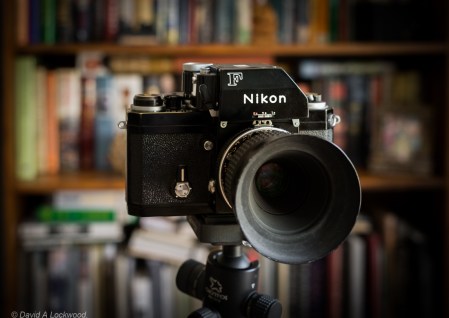 Ignoring the fact that I have more cameras than any sensible person should have – I have acquired a 1973 Nikon F (S/no says manufactured between JUL 1973 to SEP 1973) with an FTn finder.
Wanted one of these cameras for years, but would not (could not) justify the prices being asked – but this was a sensible price and more importantly, in good condition & with a working meter system: not bad for a camera nearly 43 years old ! Thanks Freyja 🙂
The only thing I found was that the meter seemed to be about one & a half stops out, but consistently over many different ‘f’ & ASA settings: which meant the ring resistor was probably just dirty. Or it had been modified to take the modern equivalent of a 1.35volt mercury battery (several methods available – all unknown on a newly acquired camera) suspicion aroused because it contained two mercury batteries that still indicated 1.3volts; how old were these I ask myself….. especially as they have been unobtainable for years.
As rumour has it that I am an electronics engineer, one of these heads should not be outside my capabilities for cleaning and minor adjustment; given the right documentation (find out were the access screws are hidden !!! ) under the top leatherette as it happens.
It turned out that at some point in time the battery-box -lead wire had corroded and this being replaced along with some judicious application of Isopropyl alcohol gave the whole thing a new lease of life, it now only reads about half a stop out compared to my Nikon D800.
All in all a happy bunny……….
The Pirate Coast.
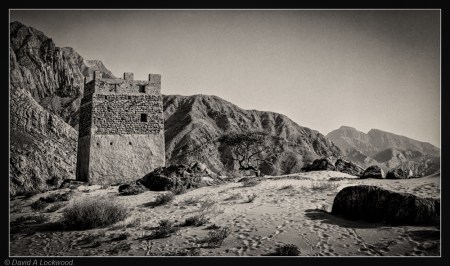 Beach watch tower near Bukhā on the Khasab coastal road.
Yashica 124G on Ilford HP5plus.
This whole section of coastline was (even a little today !) known for its piracy. Mentioned on official maps of the area as The Pirate Coast, recognised as such, all the way back to around 694 BC, when Assyrian pirates attacked traders travelling to and from India via the Persian Gulf.
One of the earliest mentions of piracy by the British came from a letter written by William Bowyear: East India Company Resident at Bushire, and his assistant, James Morley, to Henry Moore, East India Company Agent at Bussora, dated 13 July 1767
It describes a rather brutal Persian pirate named Mīr Muhannā:
“In his day, he was a major source of concern for all those who traded along the Persian Gulf and his exploits were an early factor, beyond purely commercial concerns, that led the East India Company to first become entangled in the politics of the region”
Samuel Marinus Zwemer, while traveling in the area has several interesting references about the safety of travellers: a snippet –
Oman and Eastern Arabia S. M. Zwemer: Journal entry 1907.
It may be of interest to note our mode of travel in this primitive country, where there are no beasts of prey but where every one goes armed for fear of his neighbour. I quote from my diary:
……..Our guides proceeded mounted, but with their rifles loaded and cocked; then followed the baggage-camel, to which mine was towed in Arab fashion by hitching the bridle of the one to the tail of the other; in like manner, my companion rode his beast fastened to the milch-camel, followed by its two colts.
Around 1805, the Wahhabis implemented a system of organized raids on foreign shipping. The vicegerent of the Pirate Coast, Husain bin Ali, compelled the Al Qasimi chiefs to send their vessels to plunder any trading ships of the Persian Gulf without exception. Rather lucrative because he kept at least 1/5th of the plunder for himself.
At the end of the 1809 monsoon season, British authorities in India decided to make an example of the Al Qasimi once and for all. An expedition was sent to destroy the largest of their bases and as many ships as could be found; an added bonus was to counteract French encouragement of these pirates from their embassies in Persia and Oman. By the morning of 14 November, the military expedition was over and the forces returned to their ships, suffering light casualties of five killed and 34 wounded. Arab losses were unknown, but probably significant and the damage done to the Al Qasimi fleets was severe: as a number of their vessels had been destroyed at Ras al-Khaimah.
The Pirate Coast was later called the Trucial Coast after the Treaty of Maritime Peace in Perpetuity was signed in 1853, giving the Royal Navy responsibility for the protection of shipping. It also set the seeds for what would later become the United Arab Emirates.
Old chemicals & film – not always a good mix !
 Made at about 9600ft early one morning on my Yashica 124G: using old Kodak Ektachrome sw 100 6×6 film.
Found in the back of my freezer…. age, no idea because the outer box was missing – but old ! which is why it got overlooked (well that’s my excuse anyway) I will not mention the box of old developer used.
There is some unevenness seen in the sky (like bromide drag) probably more chemical related than film. But hay-ho, it is always fun not being really sure what will come out of the tank. At least it wasn’t a completely clear strip of emulsion with a glutinous mess in the bottom of the tank; old story, as I was trying development of B&w transparencies and got the acid quantity wrong ❗
Muscat Harbour – ship names.

Left.

Right.

Further right – HMS Perseus.
Visiting Muscat harbour anchorage at the entrance to a bay overlooked by the Sultan of Oman’s Muscat palace; there has been a tradition for ships crew to paint the name of their vessel on the rocks surrounding this bay.
A lot of the names are very faded and can only be read up close from a boat, but one or two are still very distinct; HMS Perseus being one of them.
Now a problem arises:
Received wisdom says the ships name refers to:
HMS Perseus a British Parthian-class submarine built in 1929 and lost in 1941.
But there was another HMS Perseus who spent time visiting Muscat.
HMS Perseus was a 3rd Class, Protected Cruiser.
Built by Earle of Hull, laid down May-1896, launched 15-Jul-1897, and completed 1901.
On completion she went to the East Indies Station, where she spent her entire active service 1901-13.
Returned to the UK and paid off.
The diary of A. Barker whilst in service aboard the Protected Cruiser, HMS Perseus in 1901/03 at the East Indies Station. Starting from 13th September 1901, he makes several entries pertaining to Muscat.
See example of entries below.
13th After smooth passage we arrived at Muscat at 9 am. We saluted the Sultan with 21 guns which was returned.
14th We coaled ship 200 tons.
Time had been rather dull during our time up the Gulf as we had had no leave since we left Karachi so we arranged a seigning (sic) [seining or net fishing is what I think he means] party, which came off very well.
18th We received the Sultan & the British Consul on board. A salute of 21 guns for the Sultan 11 for the Consul was fired.
20th We had Divine Service which was conducted by the American Minister from ashore
21st We got the starboard bower anchor out, and then we started painting ship.
23rd We had another seigning (sic) party, which was attended by the British & American & French Consul & Mrs Cox. There being no communication from Muscat by telegraph we left Muscat on the 25th for Jask & arrived there the 26th. We left again on the 27th for Muscat.
28th We carried out our firing and arrived at Muscat. We moored ship placing spare bower on the billboard.
29th We unmoored ship and replaced spare bower anchor.
30th We left Muscat at 7.30 am with British Consul & Sultan of Muscat & 150 soldiers onboard, bound for Sur & Khora Jehoram
And another:
HMS Perseus – Light Cruiser 2,135 tons served in The Persian Gulf between 1909 and 1914:
Towards the end of the 19th Century the trafficking of arms in the Persian Gulf area had escalated to dangerous proportions. The British Government pressurised the Governments of Persia and Muscat to take action to bring this business under control. By 1897 Persia had managed to reduce the involvement of their nationals but Muscat was still a serious problem.
So this ship also visited the harbour on several occasions.
But the most interesting is this reference to a HMS Perseus crew painting their ships name in 1857, Made by members of HMS Gambia who visited in August 1958 and did the same thing.
While a few of us had thus been seeing what there was to see, or doing battle on the hockey pitch, a party of stout-hearted individuals had landed on the rocks a few hundred yards from the town where, having scaled a hundred-odd feet of mountainside, they set-to repainting the magic letters GAMBIA on the rock-face, together with the Admiral’s Flag close-by. This was not just a bright idea by one of the boys, but part of a publicity campaign which has been going on ever since H.M.S. PERSEUS painted her name on the brown rock in 1857. As a result, the cliffs either side of Muscat form what is surely the world’s biggest autograph album, for by now they are covered with the names of ships and not only R.N. ones who have visited the place.
The problem is that if the following list is correct, it would indicate that no ship called HMS Perseus existed for that time frame (1857) – so who knows.
Six ships of the Royal Navy have borne the name HMS Perseus.
HMS Perseus was a 20-gun sixth rate launched in 1776; she was the first vessel of the Royal Navy to be sheathed in copper. She was converted to a bomb vessel in 1799 and was broken up in 1805.
HMS Perseus was a 22-gun sixth rate launched in 1812. She was used for harbour service from 1818 and was broken up in 1850.
HMS Perseus was a Camelion-class wooden screw sloop launched in 1861. She was used for harbour service from 1886, was renamed HMS Defiance II in 1904 and was probably sold in 1912.
HMS Perseus was a Pelorus-class protected cruiser launched in 1897 and sold for scrap in 1914.
HMS Perseus was a Parthian-class submarine launched in 1929 and sunk in 1941 during the Second World War.
HMS Perseus was a Colossus-class aircraft carrier launched in 1944 as HMS Edgar but renamed a few months later. She was scrapped in 1958.
Dye Transfer printing – a lost art.
Dye Transfer printing – a lost art.
A printing process that although expensive & rather complicated, gave wonderful colour prints.
Unfortunately, Kodak in 1994 (the only supplier) ceased production of all materials for using this process. A great shame because the method gave incredible control of both colour & contrast for the finished print: it must be noted that this was control over sections of the print (just like in B&W printing) not just changing the look of the complete print.
The process involved taking a well exposed and developed transparency (the larger the better) and from this; producing a series of contrast masks, highlight masks, and separation negatives, you are then ready to expose the matrix film. The matrices (3 of them) are exposed with R separation & placed in a cyan dye, the G in the magenta dye and the B in yellow dye. These were then rolled out onto the dye transfer paper (in registration) with the combination of all three producing the final colour print.
Get a cup of coffee or depending on the time of day, a glass of wine and watch this entertaining short video, then look at some of the links I have provided to see the method & final result.
http://www.charlescramer.com/dyetransfer.html
http://ctein.com/postlist2.htm
It beats the hell out of sitting in front of a computer screen with Photoshop or Lightroom !!!
Nikon F4 with the AF-S Nikkor 35mm f/1.4G.


My Nikon F4 with the AF-S Nikkor 35mm f/1.4G.
Made with the D800 and 55mm f2.8 micro Ai-s Nikkor, so opposite ends of the same reasoning.
Out of curiosity I wanted to see how well (if at all) my F4 worked with the 35mm Af-s f1.4G: I can confirm that the F4 lives up to its reputation of being able to take any lens Nikon has ever made.
The lens performs very well with one caveat; no f stop ring meant the only modes I can use are: Program high, program & shutter priority. So the down side was hyper-focal focusing was not an option (overcome by focusing about a 1/3 of the way in to the image) happy days. In shutter priority I could select for aperture by turning the speed control knob and as I quite often use the camera in manual it was not a problem.
The AF focusing was decisive and fast so no worries there, in actual fact it probably means that batteries will last a lot longer. Although in all the years I have had the camera, I have never needed to replace the AA or rechargeable type in the field.
This means that I might just talk myself into buying the AF-S Nikkor 50mm f/1.8G. The 50mm f1.8 AF that I am using at the moment, has become very imprecise when focusing (age and a lot of use!) also I have the 55mm Micro Ai-s for the manual cameras.
As a matter of interest; why the f1.8 & not the f1.4 – the answer is exactly the same as with the previous 50mm AF lens; price and diminishing returns….. Looking at both lenses, the f1.8 is sharper over most of the range I use and at less cost, so at the price I could afford to do exactly what I am now considering; if I wear it out – get a new one.
If anyone is interested in the two books the camera is sitting on; they are from the Folio Society, see below from their site.
 The Icelandic Sagas
Magnus Magnusson (ed.)
Illustrated by Simon Noyes
Punctuated by a series of eerie illustrations by Simon Noyes, these great Nordic stories of mythology & exploration are chosen and prefaced by Magnus Magnusson.
Chandelier – SQGM .
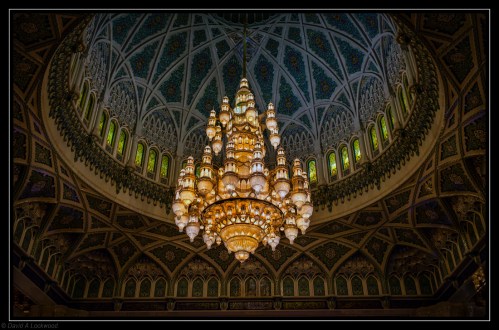 Chandelier in the main room – everyone seems to mention the very large hand-made carpet, but I think this view is the pièce de résistance on entering.
I am sorry if this is a little off in quality – needed 1600 iso and -1ev not to mention f5.6: hand-held. I wanted the detail in the chandelier but also preserve some in the ceiling.
All a bit beyond my capabilities – wanted to show how incredible the workmanship was; almost Elizabethan in its style.
The Sultan Qaboos Grand Mosque.
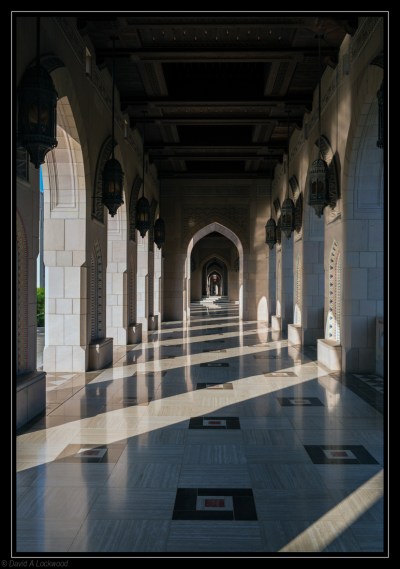 One of many covered walkways.
In 1992 HM Sultan Qaboos declared that his country should have a Grand Mosque. Building work started in 1995 and it took six years & four months to complete.
As there are National Day holidays over this weekend here in Oman, I decided that rather than joining the crowds escaping the capital, I would visit some of the local attractions.
The Grand Mosque is just down the road from where I live and as I had not been there for a number of years, I thought it was about time I went back.
An architectural delight, that avoids the ostentatious façade of wealth and splendour which a lot of modern building can have. It does have an awe-inspiring visual impact, but in a dignified way; in keeping with many of the great places of religious worship around the world.
I got there before it opened to the public (anyone can visit on any day apart from Friday) so for a couple of hours, was able to walk the grounds with only the gardeners & cleaning staff present. At 08:00 sharp – opening time, I entered the main building which was before most people would be arriving – perfect for making photographs.
A very enjoyable walk around with my camera, no restrictions on using cameras as long as one remembers and respects that the building is a place of worship.
A tranquil and carefree morning out, with a lot of images that I will work on over the coming days.
The Devil’s Gap.

Davil’s Gap.


Dima wa’Tayeen in the Sharqiya region, will take you to Wadi Tayeen and at Ghubrat at Tam, the Wadi takes a dramatic turn in a breach of the Jebel Aswad range (The Devil’s Gap) from here it takes the name Wadi Dayqah.
Note: Mariners called the sea end The Devil’s Gap but it is now generally known by this name at the Wadi Tayeen end as well.
Lieut, J.R.Wellsted – Travels in Oman 1837 Vol 1. Page 41
Extracts from:
JOURNAL OF EXCURSION IN OMAN, IN SOUTH-EAST ARABIA.
by Colonel S.B. Miles Pub:1838.
&
The Geographical Journal
Vol. 7, No. 5 (May, 1896), pp. 522-537
S. B. Miles.
The town of Ghubra el Tam (sic) is very picturesquely situated on the skirt of an eminence, which, lying at the end of the valley and thus forming a barrier against the onward progress of the stream, has caused it to swerve to the northward and cut its way through the mountain range down to the sea. It has some good houses and a population of over a thousand of the Siâbiyin tribe, and is protected by a strong fort of oblong shape perched on the western extremity of the hill.
At this time there was very little water in the wadi, the unusual dryness of its bed being due to the severe and long-continued drought, from which this part of Oman had been suffering, and our party were congratulating themselves on having arrived at such an opportune time for passing through the gorge, when their joy was suddenly turned into dismay by a slight shower of rain which fell in the evening. The clouds now began to gather so ominously in the sky, that if it had not been so late I should have pushed on at once without halting. It had, however, already become too dark to permit of this, and with some foreboding—for the intensity of the heat seemed to threaten a thunder storm—we took up our quarters for the night in the habitation our hosts the shaikhs of the town had allotted to us. Had it rained heavily, as many of us fully expected, I should have had to wait here until the torrent had subsided sufficiently to allow of our proceeding through the gap, which would undoubtedly have entailed a delay of several days.
The exploration of this caňon had been one of the main objects of my journey, as it had not before been traversed by a European, so I was resolved to seize the present chance of visiting it at all risks. Fortunately, the night passed without the expected downpour, and though the morning of the 16th broke gloomily and lowery, the rain still held off, and the stream flowing at our feet had risen but slightly. After a consultation, we deemed it best to face the peril of a sudden rush of water through the gorge, and hazard the passage before the storm, which now appeared inevitable, could burst upon us and unite the rills and streamlets of the valley into a swift and overwhelming torrent. having hastily loaded the camels, therefore, we started early, and crossed the bed of the wadi, in which the water was running a little over 2 feet deep, just opposite the town. We then found ourselves at once at the entrance of the great cleft, which is as sharp and abrupt as if we were entering the portals of some monstrous castle and stood immured within its massive walls. Towering loftily, sheer and perpendicular above the narrow floor, the huge walls of rock give the appearance as if the mountain range had been suddenly split in two from the base to the summit by some convulsion of nature, exhibiting a singular illustration of impressive grandeur. The breadth of the passage here is about 100 yards, but it varies throughout its length from 500 to 150 yards, while the cliffs rise to an altitude of from 1000 to 1500 feet, as near as I could judge. The stream appeared to flow 4 or 5 miles an hour, and gradually increases in volume as we progress, being fed by the springs of water which burst from the crevices in the walls. Throughout the chasm the camels were wading nearly up to their knees.
After riding along this grand and curious gallery for a quarter of a mile, we are told to dismount, having arrived at a sort of deep step or waterfall called the Akaba. Here the camels are relieved of their baggage and saddles, and are taken along a ledge of the precipice on the left bank which leads circuitously to the bed further on, while the men of our party are let down by a rope over the projection on to the floor of the wadi below. This remarkable stop or fall in the rock offered a very serious impediment, as it was of considerable depth, while huge blocks and fragments of blue and white limestone, that had fallen from above, added lo the difficulty, and presented an obstacle which was absolutely insuperable to the camels, even when freed of their loads. The path leading to the fall, along which we had to scramble, was so rugged and slippery, and the cliff was so smooth and waterworn, that even the Arabs, who are as nimble as cats, did not find it easy work.
The solicitude evinced for my safety, not only by my own party, but also by the Siabiyin who had accompanied us from Ghubreh was almost touching, though the descent could not in fact be called perilous. Indeed, throughout my excursions in Oman, 1 always had reason to he grateful to the Arabs of my escort, and not infrequently to the local Arab shaikhs, for their zeal and self-sacrifice on my behalf. They never resented the inconvenience and fatigue 1 often caused them, but deferred without question to my wishes as to the when and the whither; while on any occasion of unusual toil or danger, they seemed to regard my safety and comfort as a main point of consideration.
At the bottom of this pass, called Al Makuba by our Siabiyin guides, we waited an hour for the camels, which, though carefully led by the drivers, did not traverse the narrow and dangerous ledge on the other hank without serious difficulty and hazard. Fortunately, however, they arrived at last in safety, and the baggage, which had in the mean time been lowered down by the Arabs, having been replaced, we mounted and resumed our journey.
“we are told to dismount, having arrived at a sort of deep step or waterfall called the Akaba.”
This is still a difficulty even in 2015 !
Extracts from:
THE COUNTRIES AND TRIBES
OF THE PERSIAN GULF.
Pub: 1919 by COLONEL S. B. MILES
Al-Sharkiya, as its name implies, denotes the most easterly province of Oman, and is bounded on two sides by the sea, on the south-west by the desert, and divided from Oman Proper by the hill range, as described above. It is mountainous to the north along the coast, the highest peak being Sohtari, which rises over 6,000 feet,and to the south-west it is more level, more fertile, and more populous.
The northern part of Al-Sharkiya is drained by the Wady Tyeen, which flows into the Gulf of Oman, while in the south the watershed throws off four streams, Ethli, Andan, Halfam, and Kalbuh, all of which unite in one and discharge into a creek a little to the east of Mahot in the Bahr al-Hadhri. This province includes three or four luxuriant and well-watered districts, the Tyeen Valley, Jaalan, Bediyeh and by some Semed al-Shan.
The first of these is a perennial and important stream occupied by more than thirty villages, and after cutting a deep chasm through the hills known to mariners as the Devil’s Gap, reaches the sea at Dagmar, east of Kuriyat.
The great valley called by the Arabs Wady Thaika, or Hail Ghaf, and known to Europeans as the ” Devil’s Gap,” a narrow cafion cut through the hills by the water of the Wady Tyeen ; the bluff on the northern side of the gap is called Nuwai, while that on the southern is called Naab.
A Musandam Hermitage.
 A Musandam Hermitage.
The three buildings in the above image, was the home of an old gentleman who as far as I could tell, had cut himself off from his immediate family and lived a very solitary life.
Unfortunately he is now deceased; although I did have the pleasure of meeting him on a few occasions when he was walking the mountain tracks.
I remember the first time I saw him, he was walking back from one of the local villages and I stopped in case he wanted a lift. He scrambled in and proceeded to have a loud and unintelligible conversation with me (it was some form of local dialect – probably Kumzari [see below] interspersed with the local Arabic) I can get by poorly ! with the later but not a hope with the former.
Over the months, I picked him up a number of times and was greeted with a big toothy smile along with the inevitable loud unintelligible chatter. I said yes & no interspersed with insha’Allah when I thought it appropriate; he always left with profuse expressions of thanks, so I must have avoided giving offence.
This is in no way meant to sound disrespectful, but – the expectations of someone living alone in the mountains above Khasab are that they would not present the most hygienic of demeanours….. Far from it, he was clean and what struck me as rather odd, very soft hands, but with a firm handshake. So although the place looks very desolate and unkempt, he was most fastidious about his appearance; albeit rather bedraggled.
I was sad when I heard that he had died.
From that well-known online encyclopædia:-
Kumzari.
The Kumzari name derives from the historically rich mountainous village of Kumzar. The language has two main groups of speakers, one on each side of the Strait of Hormuz: by the Shihuh tribe of the Musandam Peninsula and by the Laraki community of Larak Island in Iran. On the Musandam Peninsula, the Kumzar population is concentrated in Oman, in the village of Kumzar and in a quarter of Khasab known as the Harat al-Kumzari. In addition, Kumzari is found at Dibba and the coastal villages of Elphinstone and the Malcolm Inlets. It is the mother tongue of fishermen who are descendants of the Yemeni conqueror of Oman, Malek bin Faham. Based on linguistic evidence, the presence of Kumzari in the Arabia region exists prior to the Muslim conquest of the region in the 7th Century A.D.
Although vulnerable, it survives today with between 4,000 and 5,000 speakers.
Musandam.
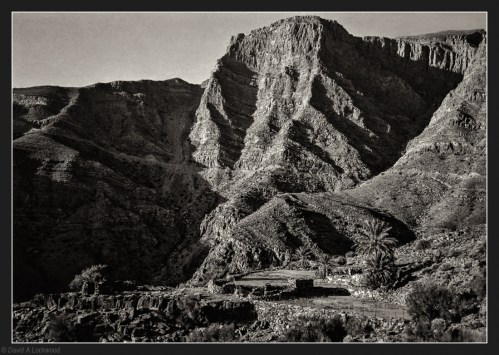 Nikon F4 with Tokina 35-70 f2.8 AIS AT-X.
This is from a negative that I saved after a whole file of them got wet when my house was inundated several years ago 😦
Thankfully a good soak in Photo-flo solution was able to save a good number of them. Although as you can see, there is some damage in the sky area as this was made on Ilford XP2 which is a dye cloud film, so not as hardy.
Most were images I had taken when I was working in the Musandam.
A little bit of history as to why Oman is split into three parts – Oman, Madha & The Musandam.
It goes back to the formation of the UAE in 1971. Prior to this, the area was little more than a collection of sheikhdoms (unlike Oman by this time) with not much in the way of formalised government. It was administered by the British as Oman & the Trucial States.
When the British withdrew from the region a decision was made to form the Trucial States into a single country, the United Arab Emirates. As you can probably imagine, there was a great deal of debate over which parts were owned by which sheikh.
Some areas were easy but were there was the possibility of dispute; the British simply asked the villagers which sheikh they owed their allegiance to. Madha decided to pledge their allegiance to Oman, so they become Omani.
With regards to Musandam; this has significant strategic importance as, with Iran, it allows control over the Straits of Hormuz. Hence Oman was able to maintain control of The Musandam in these negotiations, but didn’t win the rest of the coast, which is why Musandam is also not connected to the rest of Oman.
Failed – Devil’s Finger…….


This is about a 600ft drop.


500Ib bomb fragments.

.303 ammunition box c.1950.

A nice walk, unsuccessful in getting onto Devil’s Finger – yet again…..
The problem is; finding a route that gets onto the final ridge, without several descents & the inevitable climb-out of the many gorges that criss-cross the approach.
Google Earth is hopeless for this sort of thing and my O/S maps are not of the right scale (even worse for the SAS during the 50’s campaign) they had old style topographical maps (some copies of which I have) they used shades of colour to denote altitude. Aerial photography was nearly as bad as Google Earth.
Locals just think I am mad – “why do you want to go there? it’s just a rock” But….. may have found someone who says he knows the way – we shall see!
The weather was good and the walk interesting from a historical point of view. It became obvious that there had been some sort of combat (1950’s) which took place over a large area of the route. Lots of 500Ib bomb fragments and at least one .303 ammunition box: all found without much effort looking.
One way of passing a long weekend !! 🙂
The Devil’s finger.
A long weekend off work !! so yet another attempt to find a way of getting a hand on the ‘The Devil’s finger’ seen on the image of Jebel Akhdar below.
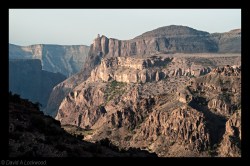
It’s the sticky-up bit seen at the end of the range of hills upper centre of this image; a long walk going from right to left.
Cairn – Jebel Shams.
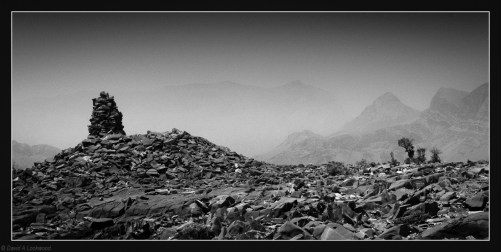 Cairn – Jebel Shams.
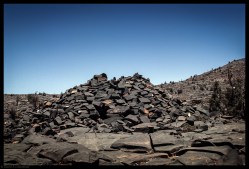
I have no idea of its age; always been there, say the locals – there are the remains of early Iron age tombs – see below and (if you know where to look) stone house foundations of probably the same period.
 David A Lockwood